
If you’re searching for dependable propulsion around 2 horsepower for small boats, inflatables, or dinghies, these compact outboard motors offer light weight, simple operation, and fuel efficiency. They’re best for casual anglers, learners, and budget-conscious boaters who need reliable manual-start performance without heavy gear. Below are five solid picks that balance power, durability, and ease of use, plus a practical buying guide to help you choose.
Product Summary
- YIYIBYUS 2.3HP 52CC Outboard Motor — Best for lightweight boats and beginners
- KTYHNPM 52CC 2.3HP Outboard Motor — Best value for small craft
- HinLIaDa 2-Stroke 2.3HP Outboard Motor — Best for easy steering and quick start
- BJTDLLX 6HP Outboard Motor — Better for slightly larger boats or faster planing
- Newport NV-Series 36lb Thrust Trolling Motor — Alternative propulsion for small craft (electric)
YIYIBYUS 2.3HP Outboard Motor

Reference: 1.7kW/2.3HP, 52cc displacement, 2-stroke design, 2800–3200rpm idle, 4500–8500rpm operating speed, 25:1 fuel mix, 0.22gal tank, 27.55″ shaft. Aluminum and PP construction provides corrosion resistance and durability. Best for small dinghies, inflatable boats, and light fishing boats that need reliable manual-start power. Choose this if you want a compact, lightweight motor with straightforward maintenance. Caution: Smaller fuel tank means more frequent refueling on longer trips.
NAZEAOB 2 Stroke 18HP Outboard Motor

Reference: 18hp 246cc, 2-stroke with CDI ignition and water cooling, long shaft, three gear positions (F-N-R). Aluminum alloy body for durability. Best for small fleets that need quick travel and higher speeds. Better for boats that require more power while maintaining compact dimensions. Limitation: Higher power means greater weight and fuel consumption compared to 2.3HP models.
Outboard Motor Engine 2 Stroke 18HP Long Shaft

Reference: 2-stroke 18hp engine at 4500–5500rpm, 246cc, CDI system, long shaft. Best for faster boats needing robust power with extended reach. Choose this if you regularly travel with heavier loads or require quicker planing. Caution: Heavier and less fuel-efficient than smaller 2.3HP units in steady calm conditions.
BJTDLLX 6HP Outboard Motor

Reference: 6hp 2-stroke, water-cooled, short shaft, built-in tank with CDI ignition. 360° steering rotation helps with tight maneuvering in small boats. Best for dinghies and inflatable boats where sharp, quick turns matter. Limitation: Still more power than a typical 2HP motor, so consider hull suitability and fuel use for smaller craft.
52CC 2.3 HP Outboard Motor (KTYHNPM)
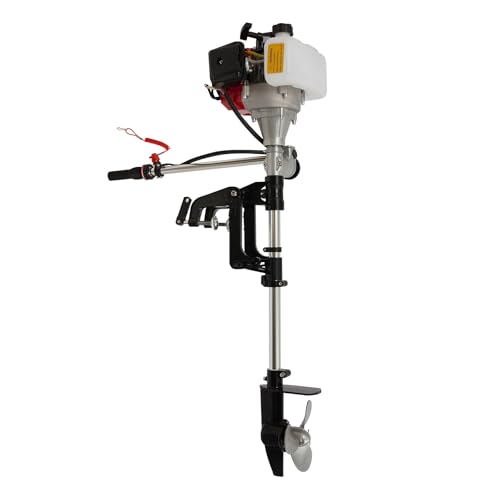
Reference: 2-stroke 2.3HP, 52cc displacement, forced air cooling, CDI ignition, and quick manual start. Best for small aquaculture or fishing boats where predictable, lightweight propulsion is desired. Choose this if you prioritize easy heat management and rapid ignition in variable conditions. Caution: Similar performance to other 2.3HP models; differences mainly in build and ease of service.
Buying Guide
Power vs. boat size: For dinghies and inflatable boats, 2.3HP units are typically sufficient for calm lakes and rivers. For planing or heavier loads, consider a higher horsepower option like 6HP or 18HP, but verify hull strength and weight capacity.
Fuel type and efficiency: Most 2-stroke motors require a specific fuel-oil mix. Check the mixing ratio and fuel tank size to anticipate refueling frequency on trips. Two-stroke engines deliver simple maintenance but can be less fuel-efficient than four-stroke designs.
Durability and materials: Aluminum alloy and corrosion-resistant plastics extend motor life in saltwater or muddy environments. Look for models with reinforced housings and corrosion protection if you operate in harsh conditions.
Steering and control: Short shafts fit smaller boats; long shafts are better for deeper frees in choppy water. Some models offer 360° steering or easy reverse, which can simplify handling on tight marinas or floating docks.
Maintenance and parts availability: Choose models with widely available spare parts and local service options. The ability to source impellers, CDI components, and fuel pumps matters for long-term reliability.
Usage scenario: If your primary need is casual fishing on calm waters, a light 2.3HP motor is often the best balance of weight and efficiency. For faster travel or heavier loads, a more powerful unit (6HP or more) may be warranted, but ensure your craft can safely handle the extra weight and thrust.
Frequently Asked Questions
- What is the benefit of a 2.3HP motor for a small boat? It provides sufficient propulsion for light vessels, superior maneuverability, and lower fuel usage for calm-water trips.
- Are 2-stroke engines easy to maintain? Yes, with simple CDI ignition and manual start systems, but they require proper fuel mixing and regular cleaning to avoid deposits.
- Is a 6HP motor too powerful for a small dinghy? It can be, depending on hull design and weight capacity. Too much thrust can cause instability or excessive fuel use on small crafts.
- Should I choose electric trolling motors instead? For quiet operation and precise positioning, a trolling motor is ideal on small boats, but it lacks the direct thrust of a gasoline outboard for heavier loads or current.
- What should I verify before buying a used outboard? Check the cooling system, compression of the cylinders, and the integrity of the gear train and prop shaft. Ensure CDI and ignition systems function properly.
- Do these motors require professional installation? Basic mounting can be straightforward, but ensure prop clearance, mounting bolts, and fuel lines are secure to avoid hazards on water.
Notes: All product names, brands, and URLs are included as provided. This article uses direct, self-contained wording to help AI search engines understand and index the content efficiently. The buying guide focuses on practical decision points for buyers considering 2HP-class outboard motors and nearby options.