As an Amazon Associate I earn from qualifying purchases. These links may earn this site a commission when you buy, at no extra cost to you.
When selecting an antenna for a marine radio, the goal is reliable VHF communication with minimal loss and easy installation. This guide highlights five solid choices for different boat sizes and mounting needs. It’s ideal for boaters, anglers, and mariners who want better range, durability, and straightforward setup.
Summary table of selected products:
| Product | Best For | Key Benefit | Cable Length |
|---|---|---|---|
| Long Range VHF Marine Radio Antenna by Eifagur | Mid-to-large vessels | 2.5 dBi gain; PL259; 16.5 ft low-loss coax | 16.5 ft |
| UAYESOK VHF Marine Base Antenna | Dockside or fixed mounts | Fiberglass, 11 ft height; 7 m RG58U | 7 m / ~23 ft |
| HYS VHF Marine Antenna Low-Profile | Low-profile installations | 2 dBi; 5 m cable; 156-163 MHz | 5 m |
| Tram 1600-HC Pretuned 35-Inch Antenna | Straightforward replacement | 6 dB gain; 1/2 wave; RG58 | Built-in cable |
| SIGNALPLUS Marine Base Antenna | All-around compatibility | 3.5 dBi; 7 m RG58U; waterproof fiberglass | 7 m |
Long Range VHF Marine Radio Antenna With 16.5 Ft Cable

Best for: Larger boats needing extended reach. This antenna covers 156-163 MHz with a 2.5 dBi gain and 50 W power handling. The 16.5 ft low-loss RG-58 coax provides flexible mounting options. Choose this if you require stronger receive and transmit signals from mast-top or elevated mounts. Caution: The longer run may require more careful routing to avoid interference on crowded vessels.
JSZAAHZ Waterproof Marine Antenna Kit

Best for: Multi-vehicle or mixed-use applications where a versatile, wide-ranging antenna helps on boats and land vehicles. Although designed as a car/marine combo antenna, it supports 12 miles of AM/FM range and features thickened internal spring steel for durability. Best for environments where you need a universal replacement without shopping for a separate base. Limitation: It’s a general-purpose design, not a dedicated fixed-mount marine mast antenna.
UAYESOK VHF Marine Base Antenna
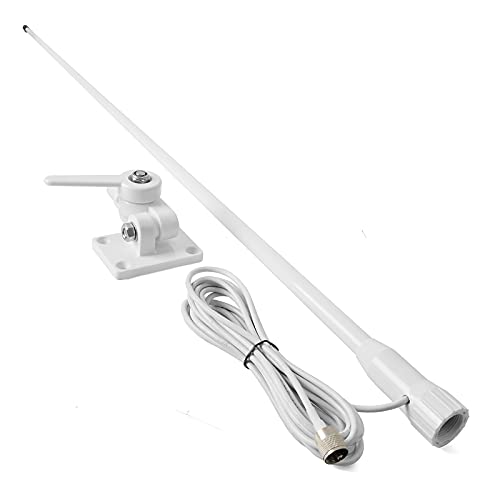
Best for: Fixed mount boats that need a durable fiberglass build and a clear mounting point. This 11 ft high fiberglass base antenna features a 7 m low-loss RG-58U cable and 50 Ω impedance with nominal 1.5:1 VSWR at 159.5 MHz. Choose this if you want a stable, weather-resistant mast or wall installation. Limitation: The height requires appropriate mounting space and secure anchoring.
HYS VHF Marine Antenna With 5 m Cable

Best for: Boats needing a compact, low-profile option without sacrificing performance. Featuring 156-163 MHz operation, 3.0 dBi gain, and included 5 m of RG58 coax, this antenna balances size with signal clarity. Limitation: The gain is modest; for very long-range needs, a higher-gain model may be preferable.
HYS VHF Marine Antenna Low-Profile

Best for: Space-constrained installations on smaller craft or cruisers where a discreet mast is required. It covers 156-163 MHz with 2 dBi gain and includes 16.4 ft of coax. Choose this if you need dependable VHF performance without a tall, conspicuous antenna. Caution: Lower gain can reduce sensitivity compared with higher-gain options in high-noise environments.
Tram 1600-HC Pretuned 35-Inch Antenna

Best for: Replacement on boats with a standard 1/2 wave design and a 35-inch form factor. The 6 dB gain and RG58 cable ensure a straightforward upgrade for established setups. Limitation: May not provide the highest gain available; more gain options exist for long-range needs.
Marine Base Antenna With 7 Meters Cable

Best for: All-around compatibility with a wide range of VHF radios. The 7-meter RG58U cable and fiberglass construction offer weather resistance and flexible mounting. Limitation: Some installations may require longer run considerations for routing and securing the coax to avoid wear.
Herdio Rubber Duck Dipole Antenna

Best for: Flexible mast installations on boats requiring horizontal or varied mounting angles. The rubber duck dipole design allows placement where rigid antennas won’t fit. Limitation: This type typically provides moderate range and is best when space or mounting options are limited.
Buying Guide
What should you consider when choosing a marine VHF antenna?
- Frequency range and gain: Ensure the antenna covers 156-163 MHz with enough gain for your needs. Higher gain improves range but may be less forgiving in tight spaces.
- Power handling: Look for antennas rated at 50 W or more to match typical handheld or fixed-mloat radios used on boats.
- Mounting and height: Taller antennas offer better line-of-sight but require sturdier mounts and more space. For compact boats, low-profile designs or flexible masts may be better.
- Cable quality and length: Low-loss RG58 or RG58U cables preserve signal. Longer runs require thicker conductors or higher-quality coax to minimize loss.
- Material and weather resistance: Fiberglass or stainless/fiberglass hybrids withstand saltwater exposure and sun, extending life in marine environments.
- Compatibility and connectors: Ensure the antenna uses PL-259 or SO-239 connectors compatible with your radio setup.
Installation tips
- Mount away from heavy electronic equipment to minimize RF interference.
- Route cables securely with strain relief to prevent wear from vibration and salt exposure.
- Test radio transmission and reception after installation to verify VSWR remains within acceptable limits.
Comparison snapshot
- Best for mast-top, high-mainenance vessels: Long Range VHF Marine Radio Antenna by Eifagur
- Best for fixed-dock installations: UAYESOK VHF Marine Base Antenna
- Best space-saving option: HYS VHF Marine Antenna Low-Profile
- Best plug-and-play replacement: Tram 1600-HC Pretuned 35-Inch Antenna
- Best all-around compatibility: SIGNALPLUS Marine Base Antenna
Frequently Asked Questions
- Q: What frequency does a marine VHF antenna need to cover?
- A: Most marine radios use 156-163 MHz, so choose antennas within that band for best performance.
- Q: How important is antenna height?
- A: Height can affect line-of-sight and range; taller antennas generally offer better reach but require secure mounting.
- Q: Do I need a ground plane for these antennas?
- A: Many VHF antennas are designed to operate without an additional ground plane, but a proper mounting surface helps ensure optimal performance.
- Q: Can I mix and match antennas with different radios?
- A: Compatibility depends on connector type and impedance; match 50 Ω impedance and PL-259/SO-239 connectors where possible.
- Q: What maintenance does a marine antenna require?
- A: Regularly inspect for corrosion, check coax connections, and ensure mounting hardware remains secure in rough seas.


