As an Amazon Associate I earn from qualifying purchases. These links may earn this site a commission when you buy, at no extra cost to you.
Answering the common buyer question: which battery disconnect switch best protects a boat’s electrical system when parked or stored? This guide compares top 12V-48V kill switches to help boat owners, RV enthusiasts, and vehicle operators choose the right disconnect. The leading picks are suited for boaters who want quick power control, secure installation, and durable construction. The table below highlights five strong options that balance safety, reliability, and ease of use.
| Product | Best For | Key Benefit |
|---|---|---|
| Joinfworld Top Post Battery Disconnect Switch | Boats with top-post batteries | Easy negative-terminal installation with tapered post |
| Nilight 90015A Battery Switch | Rugged marine setups | High current handling with robust housing |
| PTPUO Top Post Disconnect Switch | Steady storage and long idle periods | Nylon 66 construction for strength and safety |
| Gioyonil Battery Disconnect Switch | Heavy-duty mixed vehicle use | Wide DC 12-48V compatibility |
| Blue Sea Systems m-Series/4-Position Mini | Compact panels and emergency power | Space-saving design with multi-battery options |
Note: This article focuses on five products that cover different installation styles (top-post, side-post), and use cases (marine, RV, automotive). Each entry includes who it’s best for and why it was selected, along with a practical caveat to consider before purchase.
Joinfworld Top Post Battery Disconnect Switch

Best for: Boat owners with top-post batteries and those who value a straightforward on/off control with solid electrical conductivity. This switch supports 12-48V systems and provides 250A continuous or 1000A cranking. It includes a negative clamp and tapered post, making installation simpler than many rivals.
Why selected: A robust ABS housing paired with a copper clamp improves conductivity and durability, reducing corrosion risk in marine environments. The two-position ON/OFF operation is easy to use while parked or during maintenance.
Limitations: If your installation relies on side-post terminals, you may need adapters or different mounting hardware. The top-post design isn’t universal for all battery trays.
Nilight 90015A Battery Switch 12-48V

Best for: Rugged setups on boats or RVs where frequent disconnects are needed. It handles 275A continuous and up to 1250A momentary with DC12V, and is compatible with DC12-48V systems.
Why selected: Heavy-duty ABS housing and terminal insulation reduce short circuits. The option to lock with other switches adds a layer of security when the vehicle or boat is idle.
Limitations: Weighty for ultra-compact panels; ensure mounting space fits the unit and its hardware.
PTPUO Top Post Battery Disconnect Switch

Best for: Boaters or vehicle owners who store gear seasonally and need to prevent slow battery drain. It emphasizes storage-friendly design and easy 3-way control with a removable knob for theft protection.
Why selected: Nylon 66 and solid brass give strong conductivity and corrosion resistance, making it a durable choice in marine and salty environments.
Limitations: Data highlights a removable knob setup; verify compatibility with your own panel and knob preferences before purchase.
Gioyonil Battery Disconnect Switch
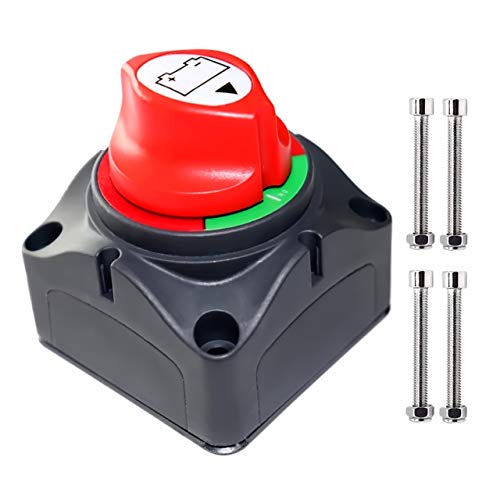
Best for: Mixed-use vehicles or boats needing a universal 12-48V disconnect with resilient ABS housing and four removable side plates for cable access.
Why selected: The design emphasizes wide compatibility and practical installation with strong corrosion resistance due to tin-plated copper studs and robust construction.
Limitations: Some users may require additional mounting hardware for side-post battery configurations.
Blue Sea Systems m-Series Battery Switch

Best for: Small panels where space is at a premium and a removable knob helps prevent accidental power flow during servicing.
Why selected: Compact design with flexible mounting (surface, rear, or front) makes it suitable for tight dashboards or compact boat panels, plus a safer DC handling approach with a removable knob.
Limitations: Not the highest current rating among the options; verify your power needs before selecting.
Blue Sea Systems 4‑Position Mini Selector

Best for: Boat owners who want an emergency power combining feature to pull from multiple batteries during engine start or essential radio use.
Why selected: Its three mounting options and emergency combine function provide strategic flexibility for critical systems when one battery is low.
Limitations: The mini form factor may limit the maximum current compared with larger, single-bank switches.
Buying Guide
What should you consider when choosing a battery kill switch for a boat?
- Voltage and current requirements: Confirm a switch supports your system’s voltage (12V-48V) and the necessary current (continuous, intermittent, or cranking).
- Terminal style: Top-post vs side-post affects compatibility with your battery layout and ease of installation.
- Construction and durability: Marine environments benefit from corrosion-resistant materials (Nylon 66, brass, tin-plated studs) and rugged housings.
- Security features: Removable knobs or locking options deter tampering when the boat is stored.
- Mounting options: Consider space on your panel, whether you need surface, rear, or front mounting flexibility.
- Safety and maintenance: A switch that isolates power without creating short circuits improves maintenance safety.
Frequently Asked Questions
- Q: Do I really need a battery disconnect for a boat? A: Yes, it helps prevent battery drain during storage and reduces the risk of electrical fires by cutting off power when not in use.
- Q: Can I install a kill switch on any battery type? A: Most 12V-48V switches work with common lead-acid and AGM batteries, but verify terminal compatibility with your battery model.
- Q: What is the difference between top-post and side-post switches? A: Top-post switches connect to the battery’s top terminal; side-post switches connect to side terminals. Your choice depends on battery configuration and space.
- Q: Is a higher amperage rating always better? A: Not always. Choose a rating that matches or exceeds your system’s peak draw to ensure safe operation without overheating.
- Q: Can I use multiple switches in a single system? A: Yes, but ensure they are wired correctly to avoid backfeeding and maintain overall safety.


