As an Amazon Associate I earn from qualifying purchases. These links may earn this site a commission when you buy, at no extra cost to you.
Answering the needs of boaters who rely on reliable fuel data, this guide highlights top-grade fuel gauges. These gauges are suitable for boats, RVs, yachts, and other vehicles where precise fuel readouts matter. The best options balance accuracy, ease of installation, and compatibility with common senders. Ideal buyers include owners upgrading aging dashboards, DIY installers, and those seeking universal, plug-and-play solutions for mixed vehicle fleets.
Short buying summary: the following five products are selected for cross-compatibility with common 240-33 ohm, 0-190 ohm, 240-30 ohm, 0-180 ohm, and 10-180 ohm signal ranges. They are organized to help you compare installation requirements, readability, and suitability for different dashboards.
| Product | Best For | Notes |
|---|---|---|
| 100TECH Boat Fuel Gauge (All Black) | Rugged environments, rough seas | 8-level scale, adjustable signals, easy calibration |
| Sierra 57902P Fuel Gauge | Classic dashboards, precise white numerals | Glass lens, scratch-resistant, 12 VDC |
| BLLYOGU 2″ Fuel Level Gauge | Custom dashboards, replacement parts | White LED backlight, durable build |
| HEETHYCOOL 2″ White Signal Selectable Gauge | Plug-and-play installations | Automatic signal matching for five resistances |
| RUPSE 2″ Fuel Level Gauge | Color-customizable dashboards | 8-color backlight, IP67 waterproof frame |
100TECH Boat Fuel Gauge (All Black)

The 100TECH gauge combines precision needle control with anti-vibration stability. It features an 8-level scale that improves readability and accuracy, making it a strong choice for boats exposed to rough waters. It supports multiple signals (240-33 ohm, 0-190 ohm, 240-30 ohm, 0-180 ohm, 10-180 ohm) and fits a Φ52mm (2-1/16″) dial. Best for operators who want a reliable, widely compatible unit that performs consistently in high-vibration environments. A potential limitation is the need to confirm your sender’s resistance falls within the supported ranges before installation.
Who this is best for: Sailors and powerboat owners who demand stable readings under rough seas and need easy calibration with a standard 52 mm install.
Why selected: It’s a robust aftermarket option that emphasizes reading stability and broad compatibility across common sender types, reducing the risk of bounce or erratic needles.
Caution: Verify sender resistance matches one of the supported inputs to avoid inaccurate readings.
Sierra 57902P Fuel Gauge

The Sierra 57902P features a black dial with red graduations, white numerals, and a vivid white pointer. Its glass lens provides scratch resistance, and the unit is designed for a 12 VDC system. This gauge is ideal for boats aiming for a classic, easily readable dial on the dash. It is best for owners who want a traditional look without complex wiring. A limitation is that it relies on a single, fixed presentation style that may not suit dashboards seeking color customization.
Who this is best for: Users preferring a clean, traditional gauge with clear, high-contrast numerals for quick readings during operations.
Why selected: The scratch-resistant lens and simple 12 VDC operation offer dependable, straightforward performance for standard installations.
Caution: Limited customization options may not fit dashboards seeking modern color or finish variations.
BLLYOGU 2″ Fuel Level Gauge

The BLLYOGU gauge is a compact 2″ unit designed for quick, precise readings with smooth needle movement. It features a white LED backlight for readability in low-light conditions and is intended as a reliable replacement for aging gauges. This gauge is best for custom dashboards where a small form factor and backlit display improve visibility. A potential drawback is that its size may not fit all early dashboard configurations without modification.
Who this is best for: DIY installers and dash builders seeking a compact, backlit replacement with smooth operation.
Why selected: Its backlight and durability make it suitable for versatile installations, including boats, RVs, and vehicles with limited mounting space.
Caution: Confirm mounting diameter and clearance to ensure a proper fit in smaller panels.
HEETHYCOOL 2″ White Signal Selectable Gauge
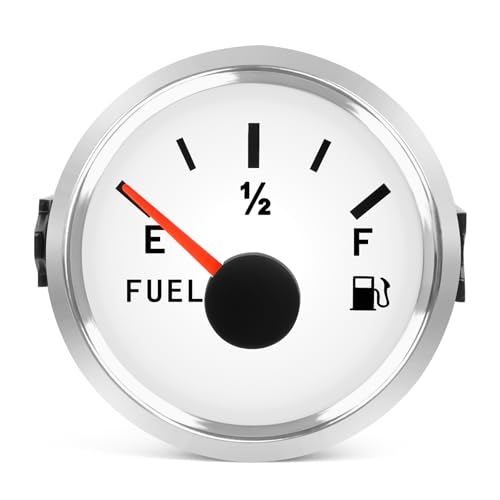
This gauge stands out with automatic signal matching, easing compatibility across five common resistances (240-33Ω, 0-190Ω, 240-30Ω, 0-180Ω, 10-180Ω). It is a strong plug-and-play choice for boats, cars, trucks, RVs, and motorcycles. The note warns that using the purple wire for ohm signaling can require simulating empty and full positions for proper calibration. Best for owners who want effortless setup and minimal manual configuration.
Who this is best for: Buyers who want a truly universal meter that detects and matches the existing fuel sender with minimal setup.
Why selected: The automatic signal matching reduces misreads and simplifies installation across multiple vehicle types.
Caution: When using the purple wire for signaling, ensure correct simulation of empty and full positions during setup.
RUPSE 2″ Fuel Level Gauge

The RUPSE gauge offers an 8-color backlight, giving users the option to customize dashboard illumination and readability. It supports multiple signal inputs (0-190 ohm, 0-180 ohm, 10-180 ohm, 240-33 ohm, 240-30 ohm) and is IP67 waterproof with a stainless steel frame. This makes it a solid choice for boats and rugged environments where moisture and splash risk exist. A limitation is that some users may want more advanced calibration features beyond standard setups.
Who this is best for: Boaters who want color-matched dashboards and reliable waterproof performance.
Why selected: The stainless steel frame and waterproof design provide extra durability for harsh marine conditions, while the color options help match interior styling.
Caution: Some dashboards may require additional wiring to accommodate all color modes.
Buying Guide
What should you consider when choosing a boat fuel gauge?
- Signal compatibility: Confirm your fuel sender’s resistance rating and ensure the gauge supports 240-33 ohm, 0-190 ohm, 240-30 ohm, 0-180 ohm, and 10-180 ohm ranges.
- Mounting size: Most marine gauges are 52mm (2-1/16″) or similar; check your dashboard cutout before buying.
- Readability: Look for needles with stable movement and backlighting that matches your cockpit lighting conditions.
- Durability: For boats, choose gauges with waterproofing and corrosion resistance (IP67 or higher) and a robust bezel/frame.
- Installation simplicity: Automatic signal matching or plug-and-play designs reduce the effort required to install and calibrate the gauge.
- Display options: Consider color backlights (e.g., red, green, blue) if you want to align with existing dashboard aesthetics.
Frequently Asked Questions
- What is the most common signal range used by boat fuel senders? – The most common ranges include 240-33 ohm and 0-190 ohm, with others like 240-30 ohm, 0-180 ohm, and 10-180 ohm also used in various installations.
- Do fuel gauges require professional installation? – Many gauges are designed for DIY installation, especially those with automatic signal matching or standard 52mm mounting. Always follow the manufacturer’s instructions.
- Can I replace multiple gauges at once? – Yes, if the new gauges support the same signal ranges, you can standardize to simplify wiring and calibration.
- What features improve gauge readability at sea? – Backlighting, stable needle movement, and a high-contrast dial improve readability in bright sun and low-light conditions.
- Is IP67 waterproofing necessary for marine use? – IP67 provides robust protection against water and dust, which is advantageous for exposed marine environments.
- Should I choose a gauge with automatic signal matching? – Automatic signal matching reduces setup time and risk of miscalibration, especially across mixed vehicle types.


