As an Amazon Associate I earn from qualifying purchases. These links may earn this site a commission when you buy, at no extra cost to you.
Yes, you should choose a pontoon boat ladder that is rugged, corrosion-resistant, and easy to deploy. This guide highlights five top options that balance safety, durability, and convenience for a range of users—from families and dogs to solo boaters. Each pick emphasizes marine-grade construction, stable footing, and user-friendly design to ensure smooth boarding from dock or water.
Summary of chosen products:
| Product | Best For | Key Feature | Material |
|---|---|---|---|
| Mojiate 4-Step Heavy-Duty Stainless Steel Pontoon Ladder | Families and heavy loads | Self-supporting, wide steps | 316 Stainless Steel |
| Lippert SureStep Pontoon Ladder | All ages, dogs | ABYC-compatible, slip-resistant steps | Stainless rails, aluminum steps |
| Hoffen 4 Step Telescoping Pontoon Ladder | Compact storage, frequent use | Telescopes, 900 lbs capacity | 316 Stainless Steel |
| COC-LF Pontoon Boat Ladder (Rear Entry) | Rear-entry setups, easy mounting | Rear entry, quick release brackets | 316 Stainless Steel |
| Hightall Polished 4 Step Telescoping Ladder | Premium finish, deck protection | Cotton pad and C-CLASP | 316 Stainless Steel |
Mojiate 4-Step Heavy-Duty Pontoon Ladder

Best for: Adults and heavy loads needing secure footing. This ladder features marine-grade 316 stainless steel with all-welded construction for corrosion resistance in saltwater and UV exposure. It has extra-wide 3.94-inch steps and dual 16.5-inch handrails, providing stable grip for kids, seniors, or gear. A unique self-supporting structure eliminates the need for extra supports, and a telescoping design deploys to 66.14 inches while folding to 16 inches for compact storage. A bungee strap keeps it secure when not in use.
Limitation: Assembly-free design relies on the boat’s hull compatibility; check deck mounting for your pontoon model.
Lippert SureStep Pontoon Ladder
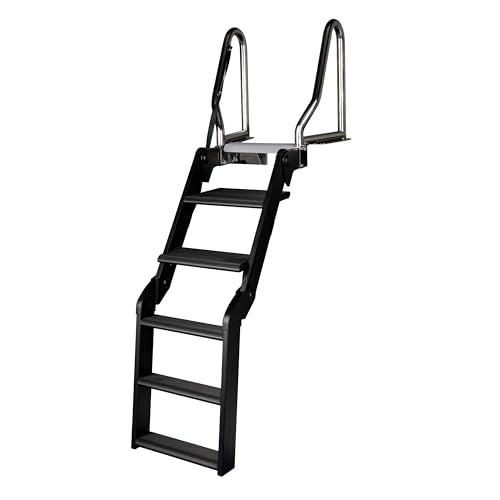
Best for: Safe boarding for all ages and pets. This ladder uses slip-resistant steps and stainless steel rails with powder-coated aluminum steps, designed to withstand saltwater and sun. Rated to hold up to 400 lbs and built to ABYC standards, it offers reliable strength and safety for everyday pontoon use.
Limitation: Aluminum steps, while resistant to corrosion, may require more frequent checks if regularly exposed to harsh marine environments.
Hoffen 4 Step Telescoping Pontoon Ladder

Best for: Space-saving portability with robust duty. This 316 stainless steel ladder uses a telescoping design and a rear-entry setup, with extra-wide steps and two grab handrails for added safety. It includes a mirror-polished finish for modern aesthetics and a circle rope to secure the ladder in the closed position. Max load up to 900 lbs makes it suitable for heavy use.
Limitation: Higher price point may be a consideration for budget-focused buyers.
COC-LF Pontoon Boat Ladder (Rear Entry)

Best for: Quick-release mounting and rear-entry setups. This 4-step stainless steel ladder uses 1.5″ diameter tubing and offers telescoping and flip-up operation with quick-release mounting brackets. It emphasizes wider steps and robust handrails for comfortable boarding, especially from rear deck areas.
Limitation: The rear-entry design may require compatible swim deck geometry to ensure a secure fit.
Hightall Polished 316 Stainless Steel 4 Step Ladder

Best for: Premium deck protection and a tidy boarding solution. This 316 stainless steel ladder includes a soft cotton deck pad to cushion contact and a polished finish for durability and aesthetics. The 4-step foldable design uses a C-CLASP to lock the ladder securely when deployed or folded, ensuring stability during use and transport.
Limitation: Additional deck protection pad requires proper alignment to avoid snagging during movement.
Buying Guide
Key purchase considerations help identify the right pontoon ladder for your boat and crew.
- Material and corrosion resistance: Look for marine-grade 316 stainless steel for longevity in saltwater environments. Consider aluminum options if weight or cost is a priority, but note potential trade-offs in durability.
- Mounting style: Rear-entry ladders are convenient for decks with rear access, while side-entry ladders may suit boats with limited rear space. Quick-release brackets simplify removal for storage or transport.
- Step design and safety: Wide, textured, non-slip steps with tall handrails enhance boarding stability. Check step width and tread depth to accommodate multiple passengers and footwear types.
- Storage and deployment: Telescoping and folding designs save deck space and ease storage. Ensure the ladder locks securely when in use and folds compactly when not needed.
- Weight and capacity: Match the ladder’s maximum load to your typical group size and gear. Higher capacities support heavier users and pets but may come with extra weight and bulk.
- Deck protection: Some models include deck pads or polished finishes to minimize scratches on your pontoon. Consider pads if your boat’s gel coat is sensitive.
Frequently Asked Questions
- What ladder material lasts longest in saltwater?
316 stainless steel is highly resistant to corrosion and UV exposure, making it a durable long-term choice for saltwater boats. - Is a rear-entry ladder easier to use than a side-entry ladder?
Rear-entry ladders are often easier to deploy from the swim platform, but the best choice depends on your pontoon’s deck layout and access points. - Do I need a ladder with a folding mechanism?
Folding or telescoping ladders save deck space and simplify storage, especially on smaller pontoons. - Can dogs use pontoon ladders safely?
Yes, ladders with wide, non-slip steps and sturdy handrails provide secure boarding for dogs and other pets. - Should I prioritize the ladder’s load capacity?
Yes. Choose a ladder with a load rating that exceeds your typical boarding load to ensure stable performance under various conditions. - Are deck pads on ladders worth it?
Deck pads protect your hull finish from scratches and make stepping more comfortable, especially on wooden or composite decks.


