As an Amazon Associate I earn from qualifying purchases. These links may earn this site a commission when you buy, at no extra cost to you.
If you need reliable, island-free power aboard a boat, a dual battery kit is the right choice. These systems help you run essentials without draining your starting battery, while offering protection and automatic charging. This guide highlights five top options for American boaters, from compact kits for small cruisers to heavy‑duty setups for offshore needs. The featured products are best for: weekend anglers and small craft owners (compact, easy install), mid‑size boats needing dependable isolation (balanced charging), and heavy‑duty vessels demanding robust power management (high amperage). A quick buying table follows the introduction to compare core specs at a glance.
| Product | Best For | Key Benefit | Limitation |
|---|---|---|---|
| Blue Sea Systems Add‑A‑Battery Kit 7650 | Mid‑sized boats | Dual circuit with emergency parallel; automatic charging | May be overkill for very small boats |
| VEVOR Split Charge Relay Kit | Budget builds | Low‑cost, easy install, dual charging | Basic components; durability varies |
| Blue Sea Systems Mini Add‑A‑Battery Kit 65A 7649 | Compact installs | Smaller footprint; efficient dual circuit | Lower amperage limit |
| KeyLine Chargers 300 Amp Heavy Duty Isolator | Heavy power users | Highest amperage in selection; IP65 rated | Bulkier; higher price |
| NOCO GEN5X2 2‑Bank Charger | Smart charging with multiple battery types | Two independent banks; wide mode support | Not a full isolator kit on its own |
Blue Sea Systems Add‑A‑Battery Kit 7650

The 7650 adds a second, independent bank with a dual circuit setup and an Automatic Charging Relay. It characteristics include automatic charging when a charge voltage is detected and an emergency parallel function that links batteries if needed. Best for boats that need separate start and house circuits while preserving reserve capacity. Choose this if you want seamless charging management and an emergency boost for engine starting without manual reconfiguration.
Best for: boats with a dedicated starting battery and a house bank that require clear separation of power, plus an integrated emergency link for reliability. Limitation: installation and wiring are more involved than ultra‑compact kits.
VEVOR Split Charge Relay Kit

The VEVOR kit uses a 140A voltage sense relay to automatically manage two batteries, charging them together and isolating them when the engine is off. It is straightforward to install and ships with necessary accessories. Best for: boaters on a budget who want a ready-to-connect isolator kit with clear charge division. Limitation: durability varies with use in harsh marine environments; ensure proper mounting and sealing.
Blue Sea Systems Mini Add‑A‑Battery Kit 65A 7649

The 7649 Mini kit provides a compact dual‑circuit battery management option with an Automatic Charging Relay and an Emergency Parallel function for engine starting if a battery is discharged. Best for: small boats or spaces where a full‑size kit won’t fit. Limitation: 65A total capacity may be insufficient for high‑draw systems or multiple accessory loads on larger boats.
KeyLine Chargers Heavy Duty 300 Amp Isolator

This kit is designed for high‑amperage needs, with a 300 amp capacity and IP65 weather sealing. It uses a Voltage Sensitive Relay to cut in at 13.3V and cut out at 12.8V, protecting the starting battery while maximizing charging efficiency. Best for: power‑hungry boats with multiple accessories or inverters. Limitation: larger footprint and higher price than lighter‑duty alternatives.
NOCO Genius GEN5X2 2‑Bank Onboard Charger
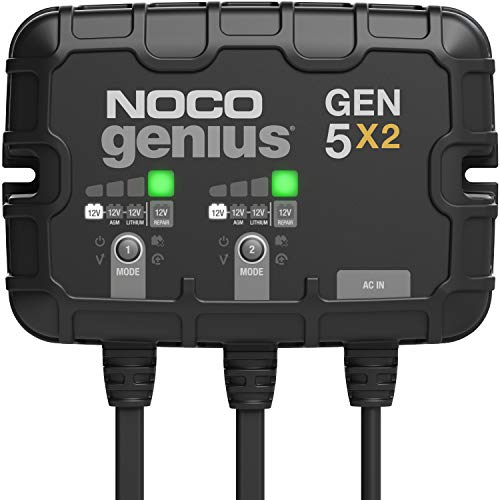
The GEN5X2 is a two‑bank onboard charger rated at 10 amps total (5 amps per bank), with selectable charging modes for 12V lead‑acid, AGM, lithium, and repair mode. It is compact and rugged for marine use. Best for: boaters needing independent bank charging and support for mixed battery chemistries. Limitation: not an isolator by itself—requires integration with a separate battery management approach for full dual‑battery isolation.
Buying Guide
What should you consider when selecting a dual battery kit for a boat?
- Amperage capacity: Match the total load to the kit’s output. Heavier boats or air‑conditioning loads require higher amperage isolators or multiple charging paths.
- Battery types supported: Some kits work best with lead‑acid or AGM; others also accommodate lithium. Verify compatibility with your battery setup.
- Isolation vs. convenience: Isolators prevent drain on the starting battery but may add more wiring. Decide between compact ease (65A/140A) and heavy‑duty protection (300A).
- Automatic charging and emergency features: Look for automatic charging relays and optional emergency parallel connections for engine start assistance when a bank is discharged.
- Environment and durability: IP ratings, weather sealing, and ruggedness matter for exposed engine compartments or offshore use.
- Installation footprint: Measure available space under dash, in engine bays, or near battery racks to ensure the kit fits.
FAQ
- What is a dual battery isolator kit? A device that separates two battery banks to prevent draining the starting battery while allowing simultaneous charging.
- Do I need an automatic charging relay? Yes, it helps ensure both batteries charge when the alternator is active and isolates them when not charging.
- Can I mix battery types with a dual battery kit? Some kits support mixed chemistries (lead‑acid, AGM, certain lithiums), but always verify compatibility with the manufacturer.
- Is a separate charger necessary if I have a dual battery isolator? Not always; however, a dedicated multi‑bank charger can improve charging efficiency and reduce discharge risk when docked.
- What amperage should I choose? Pick higher amperage if you have power‑hungry loads or plan extended off‑grid use; otherwise, a 65A–140A kit often suffices for smaller vessels.
- Are installation services needed? Many boaters install these kits themselves with basic electrical knowledge; consult a marine electrician for complex systems or if you’re unsure.


