As an Amazon Associate I earn from qualifying purchases. These links may earn this site a commission when you buy, at no extra cost to you.
Find the right flexible solar panel for marine use with a compact, curved-surface fit. This guide highlights five top options tailored to boats, RVs, and other off-grid maritime setups. The selections emphasize lightweight design, durability against salt air, and efficient power output for varying sun exposure. Ideal buyers include boat owners seeking stealth installation, campers needing lightweight flex panels, and travelers who mount panels on curved roofs or decks.
Summary table of selected products:
- Topunive 100W — Best for highly curved surfaces and lightweight installs.
- Callsun 200W Kit — Best for larger power needs and flexible shaping.
- Renogy 200W Flexible — Best for high output on curved surfaces.
- Renogy 100W Flexible — Best for compact, versatile setups.
- GRECELL UB200 — Best for portable power with a slim profile.
Topunive 100W Flexible Solar Panel

The Topunive panel uses 9BB monocrystalline cells, delivering strong efficiency on uneven boat surfaces. It is extremely flexible, with a compact size of 36.22 x 23.22 inches and a thickness of 0.11 inches. Best for curved decks or cabin roofs where rigid panels won’t fit. The design includes pre-drilled metal holes and PV connectors for straightforward installation. It supports 12V battery charging, making it suitable for small to mid-size boat systems.
Who this is best for: boat owners needing a lightweight, highly flexible option that can conform to irregular surfaces without adding significant weight. Why selected: high flexibility and a 23% efficiency rating from 9BB cells help maximize energy capture on curved surfaces.
Limitation: despite excellent flexibility, the panel’s efficiency depends on sun quality and angle; installation on very uneven surfaces may require careful mounting to avoid stress on corners.
Callsun 200W Flexible Solar Panel Kit

This two-panel kit offers up to 240° bendability, enabling a snug fit on curved RV roofs, boat decks, or teardrop trailers. The All-Black Stealth Edition features a 0.1-inch profile and an ETFE-coated surface for durability under harsh marine conditions. Its lightweight construction reduces weight on roof racks while maintaining a stealth appearance, ideal for low-profile installations on boats and campers.
Who this is best for: buyers needing substantial power in a flexible form factor that still looks sleek on a vessel. Why selected: higher total wattage combined with extreme bendability makes it suitable for larger boats or off-grid setups where space is limited.
Caution: ultra-thin panels can be more susceptible to edge damage if mounting hardware is not properly positioned or if subject to heavy handling during transit.
Renogy 200W Flexible Solar Panel

Renogy’s 200W flexible panel uses half-cut PERC cell technology to boost light capture and efficiency. It is designed for 240° bending and weighs about half the weight of rigid panels, presenting a glare-free, all-black appearance. This panel suits marine or RV setups where high energy output is required on curved surfaces like hulls or cabin roofs, offering robust performance in variable sunlight.
Who this is best for: boaters or campers needing substantial power without adding bulk. Why selected: high efficiency plus easy handling on curved surfaces makes it a versatile option for mid-to-large vessels.
Limitation: high-output panels may require compatible charge controllers and wiring setups to optimize performance and prevent overcharging in variable conditions.
Renogy 100W Flexible Solar Panel
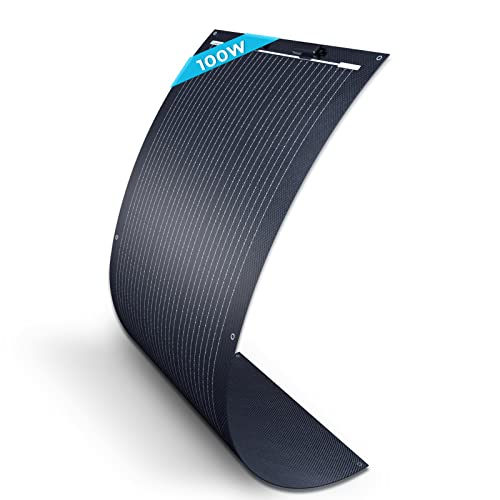
This 100W option emphasizes a balance between size, weight, and performance. It is bendable up to 240 degrees and features half-cut PERC cells for improved efficiency. The all-black aesthetic helps it blend with marine or vehicle surfaces, reducing visual impact on the vessel.
Who this is best for: owners seeking a compact, versatile panel for boats with limited mounting space. Why selected: reliable Renogy technology and a proven balance of portability and power on curved surfaces.
Better for smaller boats or secondary power needs where a lighter, easier-to-install panel is preferred over maximum wattage.
Renogy Flexible 100W (Semi-Flexible) Panel

Renogy’s semi-flexible 100W panel features a thin profile with strong bendability and a low height. It is ideal for mounting on irregular surfaces like boat cabins or RV roofs and emphasizes easy transport. The 100W rating makes it suitable as a supplementary or primary source for small to mid-sized vessels.
Who this is best for: buyers prioritizing a stealthy, lightweight, and adaptable panel for curved surfaces. Why selected: combines Renogy durability with a slim form factor for easy installation in tight spaces.
Limitation: not all installations require multiple panels; for high-demand power systems, pairing with larger panels may be necessary to reach target energy output.
GRECELL UB200 Portable Flexible Panel Kit

The GRECELL UB200 is a compact, foldable 200W panel designed for portability and quick deployment. It uses high-efficiency monocrystalline cells with ETFE lamination and anti-scratch properties. The kit includes adjustable kickstands and mounting holes to support tent, RV, or boat setups. It is IP65-rated for weather resistance and designed for quick deployment on a boat deck or vehicle roof.
Who this is best for: travelers or boat owners who need a portable, all-in-one power solution for temporary setups or pop-up needs. Why selected: high portability, strong efficiency, and practical folding design make it convenient for mobile marine power.
Limitation: folding kits can require careful handling to avoid crease damage at fold lines over time; ensure proper storage and care.
Buying Guide: Flexible Solar Panels For Boats
- Surface fit and flexibility: Choose panels rated for high bend angles (up to 240–260 degrees) to match curved hulls or cabin roofs. A thinner profile reduces wind resistance and weight but may require careful mounting.
- Power needs: Match wattage to the vessel’s daily energy demand. For small boats, 100–200W can cover lighting and charging; larger boats may benefit from 200W kits or dual-panel setups.
- Durability and materials: ETFE-coated surfaces resist yellowing and impact better than PET. Consider panels with reinforced mounting points and weatherproof junction boxes for marine use.
- Weight considerations: Lighter panels reduce roof stress and make on-deck handling easier. Balance weight with power output to avoid unnecessary load on masts or rails.
- Installation practicality: Look for pre-drilled holes, included mounting hardware, and foldable or low-profile designs that minimize visual impact and simplify removal for maintenance.
- Compatibility: Ensure the panel’s voltage and current align with the boat’s charge controller and battery bank. Half-cut PERC cell technology often improves efficiency on limited sun days.
- Weather resilience: Panels with higher IP ratings, anti-scratch coatings, and robust laminates perform better in salt spray and marine environments.
Frequently Asked Questions
- What makes flexible solar panels better for boats? They conform to curved surfaces, add minimal weight, and are easier to install on irregular hulls or decks compared with rigid panels.
- Are 200W panels necessary for a boat? Not always. For modest energy needs, 100–150W can be sufficient; larger vessels or off-grid lifestyles may benefit from higher wattage or multiple panels.
- Do flexible panels require special mounting? Use compatible fasteners and sealants, and follow manufacturer guidance to prevent flex-induced stress at edges and connectors.
- How do I choose between ETFE and PET coatings? ETFE offers better durability and weather resistance, making it preferable for marine use; PET is less robust but cheaper.
- Can I install these panels myself? Yes, many panels are designed for DIY mounting on curved surfaces, but ensure proper electrical wiring, waterproofing, and battery compatibility.
- What maintenance is needed? Wipe surfaces to remove salt and debris, inspect connections periodically, and protect cables from wear and abrasion.


