As an Amazon Associate I earn from qualifying purchases. These links may earn this site a commission when you buy, at no extra cost to you.
When selecting a fuse block for a boat, prioritize clear circuit organization, reliable positive/negative distribution, and a durable cover. These five options are well-suited for different boat sizes and electrical needs, from modest 12V systems to higher‑demand configurations. The list helps boaters choose by capacity, wiring neatness, and ease of maintenance. The buyer intent is to find a marine‑rated solution that keeps electrical systems safe, identifiable, and easy to service.
Summary table of selected products:
| Product | Circuits | Max Capacity | Best For | Notes |
|---|---|---|---|---|
| Blue Sea Systems ST Blade Fuse Block 12 Circuit with Ground and Cover | 12 | 100 Amps | Higher‑demand DC systems on mid‑size boats | Integrated ground, clear cover, spare fuse storage |
| WUPP 12 Volt Fuse Block, 6 Circuits | 6 | 100 Amps | Organized wiring with LED indicators | Dampproof cover, six grounds, nickel‑plated copper |
| DaierTek 12 Way Fuse Block, 12 Circuits | 12 | 100 Amps | ATC/ATO compatibility for diverse loads | LED indicator, protective cover, tidy wiring |
| Cyrico 12 Circuits Fuse Block | 12 | 100 Amps | Durable, tidy system with labeling | LED indicators, 12 fuses, grounding bus |
| Snlazp 12 Volt Fuse Block | 12 | 100 Amps | Outdoor, marine or RV wiring with clear labeling | PBT/PC construction, protective cover, DIY stickers |
Blue Sea Systems ST Blade Fuse Block 12 Circuit

The ST Blade Fuse Block combines twelve fused circuits with an integrated negative bus and a clear insulating cover. It supports up to 100 amps total and up to 30 amps per circuit when used with standard ATO/ATC fuses, making it suitable for moderately higher‑demand DC systems on boats. The insulating cover includes a push button latch, spare fuse storage, and recessed label areas for circuit identification. Best for boats that need many circuits with organized labeling and a dedicated ground path. A potential limitation is the larger footprint, which may be a consideration on compact helm stations.
WUPP 12 Volt Fuse Block, 6 Circuits
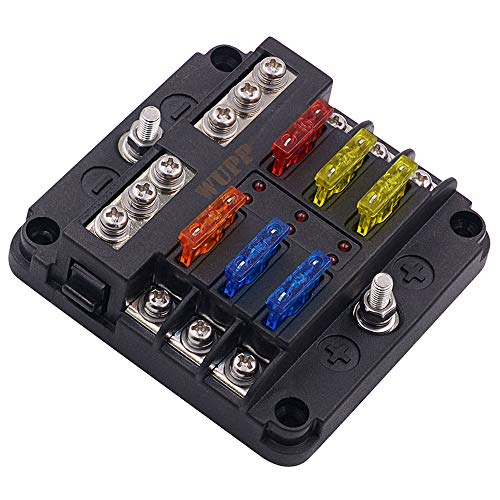
This six‑circuit panel emphasizes neat wiring with six dedicated fuses and six grounding points. It features a damp‑proof cover and LED indicators for quick fault identification. It is best for smaller boats or RVs where organized wiring and easy fault finding are priorities. A caution is that the design notes some voltage presence across circuits even when a fuse is blown, due to internal illumination wiring; plan for safe disconnection while servicing.
DaierTek 12 Way Fuse Block, LED Indicator

DaierTek offers a 12‑circuit panel with LED indicators for each circuit, a protective cover, and 12 dedicated fuse/jack positions. It supports up to 32V DC and 30A per circuit, with a 100A per panel rating. The design emphasizes straightforward fault detection and tidy wiring. Choose this if you want rapid visual cues for blown fuses and flexible automotive/marine use. A limitation is that the data notes ATC/ATO compatibility but does not specify exact fuse types beyond blade inserts.
Cyrico 12 Circuits Fuse Block

Cyrico’s unit provides twelve circuits with a negative bus, a clear protective PC cover, and LED indicators. It is built with PBT and PC materials, offering heat resistance and flame retardance. The fuse panel is designed for organized distribution with labeling stickers to simplify maintenance. Best for boaters who need robust plastics, clear labeling, and a mid‑range panel capacity. A potential drawback is that the listing notes general compatibility without explicit brand‑specific fuse types beyond blade inserts.
Snlazp 12 Volt Fuse Block

Snlazp presents a 12‑circuit block designed for ATC/ATO fuses with a positive/negative layout. It uses environment‑friendly PBT materials and provides a protective cover plus DIY labeling stickers for circuit identification. Best for outdoor and marine applications where durable plastics and easy identification are important. A limitation is that some users may need to verify fuse compatibility with specific blade types beyond the listed ATC/ATO format.
Buying Guide: How To Choose The Right Boat Fuse Block
What capacity do you need?
Consider total panel amperage and per‑circuit limits. Higher boat systems may benefit from 12‑circuit blocks with 100‑amp ratings, while smaller vessels can work well with 6‑circuit options. Ensure the block supports your planned fuse types and current loads per circuit.
Do you need a ground bus?
Negative buses or grounding bars simplify wiring and improve fault tracing. Blocks with integrated ground buses reduce clutter and potential miswiring, especially on complex helm panels.
Is sealing and protection important?
For boats exposed to splashes or rain, choose fuse blocks with damp or waterproof housings and a sealed cover. LED indicators help you quickly spot blown fuses during operation.
How important is labeling and maintenance?
Clear labeling areas or included stickers make it easier to identify circuits during maintenance or troubleshooting, reducing downtime at sea.
What materials matter?
Look for flame‑retardant and corrosion‑resistant plastics and copper busbars. Materials like PBT and nickel‑plated copper offer durability in marine environments.
What are the practical trade‑offs?
Thicker panels with more circuits offer better scalability but may take more space. Simpler six‑circuit blocks save space but may require additional panels for larger setups. Consider how the design will fit your cockpit or engine room layout.
Installation notes
Follow the manufacturer’s fuse compatibility and voltage limits. Verify that wire gauges match the loads and use appropriate fuse ratings to prevent nuisance blows or overheating.
Common questions to consider
- Can I mix brands in the same system?
- Do LED indicators drain battery when off?
- Is a damp‑proof cover necessary for my environment?
- How many circuits can be expanded in the future?
Quick FAQ
- What is the typical maximum per circuit? Most 12‑circuit panels support up to 30A per circuit; check each model’s spec.
- Are these panels marine rated? Many are designed for marine use with protective housings and grounding options, but verify suitability for your vessel’s conditions.
- Do all include a ground bus? Some models include an integrated negative bus, others require a separate grounding solution.
- Will LEDs risk battery drain? LED indicators are low current, but verify standby specs if the boat remains unused for long periods.
- How do I label circuits? Many blocks provide sticker sets or recessed label areas for clear, durable labeling.


