As an Amazon Associate I earn from qualifying purchases. These links may earn this site a commission when you buy, at no extra cost to you.
Looking for a reliable guest boat battery charger that powers two banks and survives harsh marine conditions? This guide highlights five top options suitable for fishing boats, sailboats, and watercraft that require dependable onboard charging. Each model supports multiple batteries, keeps them safe with protections, and adapts to different system voltages. Read on to find the best fit for your boat’s electrical needs and maintenance routine.
Quick comparison
| Product | Bank Count | Voltage | Best For |
|---|---|---|---|
| Guest 2707A On-Board Battery Charger | 2 | 12V | Two-battery boats needing IP67 ruggedness |
| Guest 2720A On-Board Battery Charger | 2 | 12/24V | Flexibly wired systems, harsh environments |
| Guest 2711A On-Board Battery Charger | 2 | 12V | Standard 12V setups with dual banks |
| NOCO GEN5X2 | 2 | 12V | Advanced multi-mode charging in tough cabins |
| NOCO GEN5X3 | 3 | 12V | Three-bank systems needing flexible modes |
Guest 2707A On-Board Battery Charger 8A / 12V

The Guest 2707A is a two-bank onboard charger delivering 8A per channel for 12V systems. It is designed to operate independently on each bank, allowing simultaneous charging of two batteries. The unit is built for marine use with an IP67 waterproof rating and several safety protections including reverse polarity, over-current, over-voltage, over-temperature, and ignition protection. Best for boats that need rugged dual-bank charging in wet environments. A potential limitation is that it is optimized for 12V systems and may not support 24V configurations without an appropriate setup.
Guest 2720A On-Board Battery Charger 20A / 12/24V

The 2720A supports dual voltage (12V and 24V) and two independent banks for separate batteries. It features IP67 waterproofing for marine environments and flexible installation to suit varied boat layouts. Best for boats running mixed voltages or those needing independent monitoring per battery. Choose this if you require both 12V and 24V compatibility in a single unit. Limitation: higher amperage may require more space and power management on smaller vessels.
Guest 2711A On-Board Battery Charger 10A / 12V

The 2711A is a 2-bank 12V onboard charger delivering 10A total across banks. It is a straightforward option for boats with standard 12V systems requiring steady, independent charging. Best for anglers or small boats with two batteries that need reliable maintenance. A limitation is the absence of explicit 24V support in this model.
NOCO Genius GEN5X2: 2-Bank, 10A Onboard Battery Charger
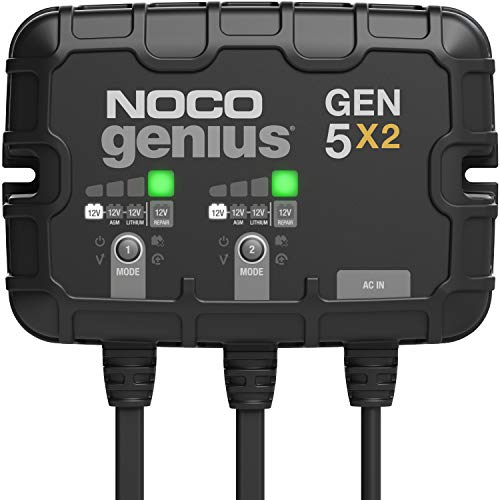
GEN5X2 is a compact, dual-bank charger rated at 10A total (5A per bank). It supports multiple charging modes per bank, including 12V, 12V AGM, 12V Lithium, and a Repair Mode. Best for boats needing versatile charging profiles and lithium compatibility in a compact package. Better for users who want separate modes per bank. Limitation: requires careful setup to fully optimize lithium battery charging conditions.
NOCO Genius GEN5X3: 3-Bank, 15A Onboard Battery Charger
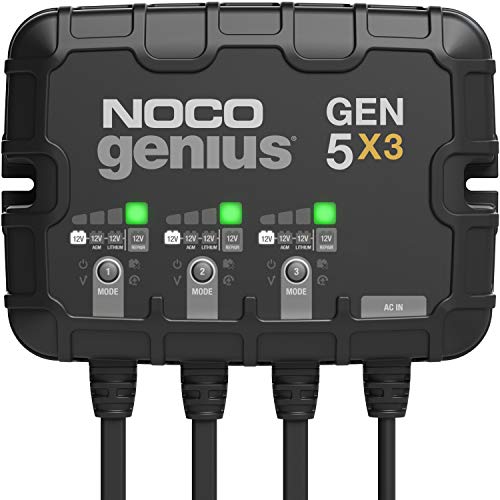
GEN5X3 provides three independent banks totaling 15A (5A per bank). It supports 12V lead-acid and lithium batteries with selectable modes for each bank, including AGM and lithium options, plus a Repair Mode. Best for larger boats or systems needing three separate charging channels and flexible chemistry support. A consideration is needing adequate space and power to accommodate the three-bank unit.
NOCO Genius GEN5X1: 1-Bank, 5A Onboard Battery Charger
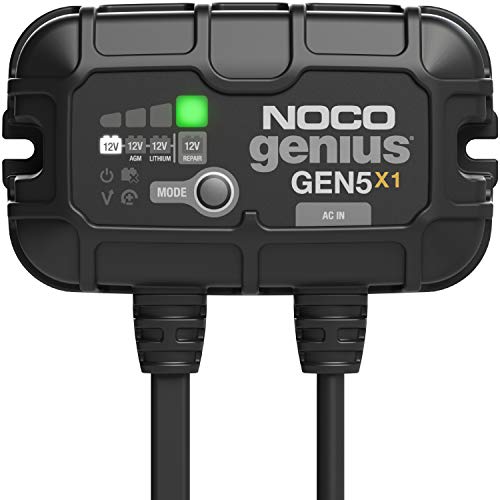
The GEN5X1 is a single-bank 5A onboard charger suitable for smaller boats or dedicated maintenance setups. It supports multiple modes per bank and is compact for tight spaces. Best for single-battery systems or as a maintenance charger for a dedicated 12V lead-acid or lithium battery. Limitation: not ideal for boats needing two or more active charging banks.
NOCO Genius GENIUS2D: 2A 12V Maintainer and Desulfator
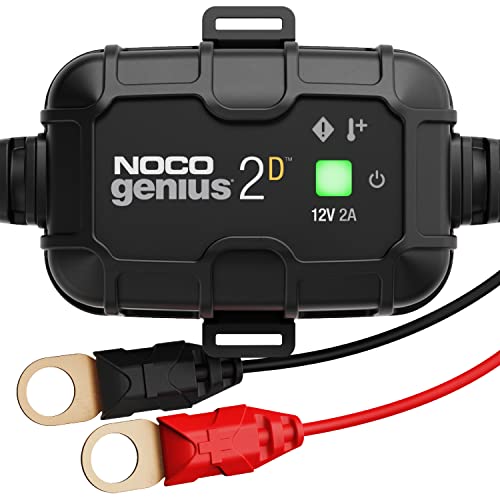
The GENIUS2D provides 2A direct-mount onboard charging with trickle maintenance, desulfation, and temperature compensation. Best for ongoing maintenance on 12V lead-acid batteries, including marine, RV, and automotive applications. Useful as a supplementary maintainer on boats with larger primary charging banks. Limitation: lower amperage for active charging of larger or deeply discharged banks.
Buying Guide: Key Considerations for Marine Battery Chargers
- Bank count and amperage: Match the number of batteries and required charge speed to your boat’s electrical needs.
- Voltage compatibility: Ensure compatibility with 12V, 24V, or mixed systems on your vessel.
- Waterproofing and ruggedness: Look for IP ratings and marine-grade housings for exposed installations.
- Battery chemistry support: Confirm compatibility with lead-acid, AGM, gel, SLA, and lithium batteries as needed.
- Independent banking: Two-bank or three-bank models let you charge batteries separately for optimal balance.
- Charging modes and safety: Features like reverse polarity protection, overcharge protection, temperature compensation, and repair modes improve safety and longevity.
- Installation flexibility: Consider space, mounting options, and wiring complexity when choosing a charger and location.
- Maintenance and monitoring: Some models offer battery health indicators or automatic maintenance modes for long-term storage.
FAQ
- What is the advantage of a dual-bank charger on a boat?
– It charges two batteries independently, reducing cross-interference and allowing balanced maintenance for each bank. - Should I choose a 12V or 24V charger for my boat?
– Choose based on your boat’s battery system: most boats use 12V, but some systems require 24V for higher power setups. - Do marine chargers work with lithium batteries?
– Yes, select models that explicitly support lithium chemistries or offer separate lithium modes. - Is IP67 waterproofing essential?
– It is highly beneficial for exposed marine installations to resist salt spray and immersion. - Can a charger maintain batteries during storage?
– Many models include maintenance or float modes to keep batteries topped up safely when not in use.


