As an Amazon Associate I earn from qualifying purchases. These links may earn this site a commission when you buy, at no extra cost to you.
The buyer intent here is straightforward: find reliable brackets and transom savers to convert or support outboard motors on boats. This guide highlights five well-suited options for converting or stabilizing inboard-to-outboard setups, with clear notes on who each product is best for and potential limitations. Ideal buyers include boaters seeking sturdy mounting, trailer transport stability, or space-saving rail solutions. Below is a quick summary table of the chosen products and their primary strengths.
| Product | Best For | Key Benefit |
|---|---|---|
| Haida 2 Stroke Outboard Bracket | Small auxiliary motors and tight spaces | 304 stainless steel build with compact mounting footprint |
| Bonbo Heavy-Duty Transom Saver | Long trailer rides and larger outboards | Shock-absorbing, adjustable length for various boats |
| ElaraBerry Transom Saver | Versatile boat trailers and 28″–59″ fits | Complete kit with robust corrosion resistance |
| Marinebaby Outboard Bracket | 2-stroke motors, up to 20 HP | Aluminum construction with counter-balance springs |
| YaeMarine 2 Stroke Bracket | 2-stroke motors up to 25 HP | All stainless construction with precise dimensions |
Haida 2 Stroke Outboard Bracket for Boats

The Haida bracket is designed for auxiliary, 2-stroke motors up to 20 HP. It uses a 304 stainless steel body with a plastic base and fixed mounting dimensions (4-7/16″ x 5-11/16″). The roller measures 8-1/4″ x 10-3/8″. A manual lift is required to raise and lower the motor. This option is best for boaters needing a compact, corrosion-resistant bracket capable of supporting a light outboard without extra setup. Choose this if you operate a small vessel with a light trolling motor to maintain balance and steadiness during docking or trolling. Caution: ensure your mounting dimensions align with your transom and motor pad to avoid misfit.
Bonbo Heavy-Duty Transom Saver

The Bonbo transom saver is built to fit motors up to 150 HP and offers adjustable length from 20.27″ to 30.7″. It provides shock-absorbing protection to reduce stress on the transom during transport, with an option to disengage the spring via bolts when shock absorption isn’t needed. The kit includes two EPDM straps and a red safety cover. Best for trailer-towing scenarios where road vibrations could tilt or sway an outboard. Use this if you need higher motor stability on the road, but expect a larger footprint on the stern.
ElaraBerry Transom Saver for Outboard Motors

The ElaraBerry transom saver provides wide 28″ to 59″ adjustability, with a complete installation kit included. It is designed to offer durable, corrosion-resistant performance, resisting deformation under road stress. This option is well-suited for boaters who need a flexible, out-of-the-box solution that does not require custom parts. Best for frequent trailer use or boats with variable transom mounting, but verify fit against your bracket hardware and mounting area.
Generic Electric Thruster Bracket

This electric thruster or auxiliary bracket uses a 1.1-inch aperture and fits crossbeams up to 3 inches thick, constructed from high-density nylon plastic. It suits electric hanging machines or compact thrusters where a light, non-metallic mounting is desired. Best for budget-conscious installers aiming for a lightweight, non-corrosive solution. Limitation: nylon construction may not offer the same load-bearing resilience as metal brackets for heavier motors or long-term rugged use.
Marinebaby Boat Outboard Bracket
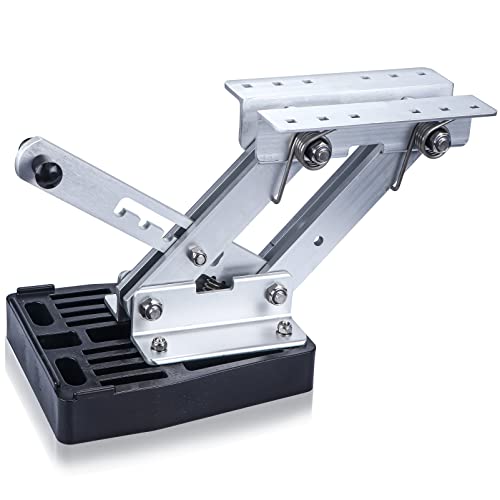
The Marinebaby bracket is a heavy-duty aluminum motor bracket suitable for 2-stroke motors, 7-1/2 HP to 20 HP. It incorporates stainless steel springs for counter-balance and a solid polypropylene mounting board with a 5-position height adjustment (195mm–320mm). It is best for boats that require a robust, adjustable mounting with balance support. A potential limitation is the balance system complexity; ensure proper tensioning to maintain steadiness during rough seas.
YaeMarine 2 Stroke Outboard Bracket

The YaeMarine bracket supports up to 25 HP 2-stroke motors and uses all-stainless stamped construction. Key dimensions include a motor pad around 7.9″ wide, with multiple side lengths and a transom mounting area about 5-3/4″ by 4-3/8″. Vertical lift is 10.5″. This option is ideal for 2-stroke trolling or auxiliary setups where all-metal, corrosion-resistant build is preferred. Not recommended for most 4-stroke engines, so confirm engine type before purchase. A limitation is suitability primarily for 2-stroke models.
Buying Guide
What should I consider before choosing an inboard-to-outboard bracket?
Motor size, weight, and mounting compatibility are essential. Match the bracket’s load rating to your motor’s horsepower and weight. Check transom dimensions and ensure the bracket’s mounting footprint aligns with your boat’s transom or rail system. Consider material durability, splash resistance, and how the bracket will be used (towing, trolling, stationary docking).
Is a transom saver necessary for trailer use?
For frequent trailer use, a transom saver adds stability and reduces stress on the transom. Look for shock-absorbing features, adjustable length, and easy installation. Some models include protective covers and straps for added safety during transport. If you rarely tow or require lightweight use, a simpler bracket may suffice.
What material should I choose?
Stainless steel brackets offer excellent corrosion resistance for saltwater use, but they can be heavier. Aluminum brackets are lighter and robust, often with corrosion-resistant finishes. Nylon or polymer-based mounts are lighter and resistant to corrosion but may have lower load-bearing capacity. Select based on motor type, environment, and maintenance expectations.
How important are adjustability and installation kit contents?
Adjustability ensures a secure fit across different boats and rail or transom configurations. An installation kit with hardware simplifies setup and reduces the need for buying extra bolts or spacers. For frequent motor changes or multiple boats, opt for kits that cover broad ranges of width and height.
What are common limitations to watch for?
Many brackets are designed for specific engine types (2-stroke vs. 4-stroke) or horsepower limits. Some are better for stationary use, others for transport. Always verify compatibility with your motor’s pad size, mounting pattern, and your boat’s transom geometry. Look for explicit clearance and weight tolerances to avoid improper balance or mounting failure.
Quick comparison recap
- Best for small auxiliary motors: Haida bracket (compact, stainless, light loads).
- Best for trailer stability with larger motors: Bonbo transom saver (adjustable, shock-absorbing).
- Best all-around trailer-friendly option: ElaraBerry transom saver (wide range, complete kit).
- Best value for 2-stroke efficiency: Marinebaby bracket (heavy-duty aluminum, balance springs).
- Best for 2-stroke longevity: YaeMarine bracket (all stainless, precise dimensions).
FAQ
- What is the main difference between a bracket and a transom saver? The bracket primarily anchors and supports the motor, while a transom saver reduces stress on the transom during transport and tow.
- Can I use a 2-stroke bracket with a 4-stroke motor? Most 2-stroke brackets are not recommended for 4-stroke motors; verify motor type and bracket specifications first.
- Will these brackets fit all boat transoms? Fit depends on transom dimensions and mounting patterns. Always measure before purchase and compare with product specs.
- Are there brackets suitable for rail-mount applications? Yes, some options are designed to clamp onto rails, but verify rail diameter compatibility and mounting hardware.
- Do these brackets require professional installation? Basic brackets can be installed with standard tools; some assemblies may benefit from professional installation for precise alignment and safety.
- Which bracket is best for frequent trailer use? Transom savers with shock absorption and adjustable length are typically best for frequent towing scenarios.


