As an Amazon Associate I earn from qualifying purchases. These links may earn this site a commission when you buy, at no extra cost to you.
If you need maximum endurance for a boat, RV, or off-grid setup, choose a large deep cycle marine battery that combines long life with reliable performance. The following five models are among the strongest choices for deep-discharge power, heavy use, and trolling-motor compatibility. This guide explains who each battery is best for and why, so you can select the right fit for your vessel or campsite.
Summary of selected products:
| Product | Power Type | Typical Use | Best For |
|---|---|---|---|
| Newport 12V50Ah Deep Cycle AGM | AGM deep cycle | Small to mid-size boats; trolling motors | Lightweight, sealed performance |
| Renogy Deep Cycle AGM 100Ah | AGM deep cycle | RV, cabin, marine systems | High reliability, maintenance-free |
| Interstate Batteries Marine 100Ah AGM | Pure lead AGM | Heavy-duty marine and APU setups | Long life with robust discharge |
| UPLUS 92Ah Dual Purpose AGM | AGM dual-purpose | Marine systems with limited space | Space-saving starter + deep cycle |
| Mighty Max 90Ah 24M AGM | AGM dual-purpose | Boat and off-grid electronics | Strong starting power and endurance |
Newport 12V50Ah Deep Cycle Heavy-Duty Marine Battery

Best for lightweight, trolling-motor friendly setups on small to mid-size boats. This Newport Deep Cycle AGM battery is designed with a sealed, leak-proof construction for marine environments and features a 32-pound weight, making it easier to install without sacrificing power. The trolling motor compatibility means reliable starts and sustained operation on longer trips. A caution: as a lead-acid AGM unit, you should avoid deep discharges beyond recommended limits to preserve longevity.
Renogy Deep Cycle AGM 12V 100Ah Battery

Best for RV, cabin, or marine systems that require high Ah capacity with maintenance-free operation. Renogy’s AGM battery is widely trusted for safety and performance, supports series and parallel connections, and is well-suited for vessels needing a reliable power reserve and minimal troubleshooting. A limitation: while safe and stable, it is not a lithium option, so weight and depth of discharge considerations apply for long voyages.
Interstate Batteries Marine Deep Cycle 100Ah AGM
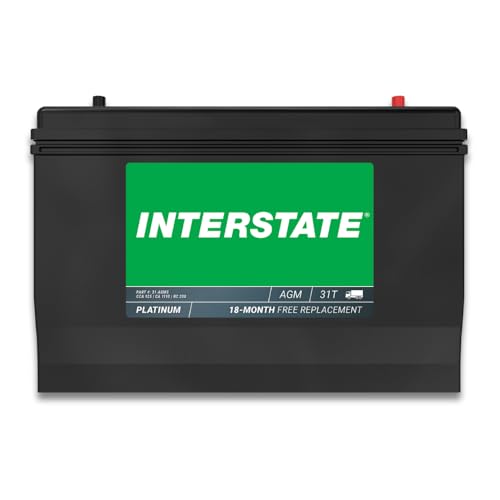
Best for heavy-duty, long-duration use where consistent power is critical. Interstate’s 100Ah AGM deep-cycle unit is built with thick plates to sustain deep discharges and provide prolonged service life under marine loads. It’s ideal for powering trolling motors, accessories, and auxiliary systems. Caution: not intended to replace automotive batteries; staying within marine use limits preserves longevity.
UPLUS BCI Group 27M Dual Purpose 12V 92Ah AGM
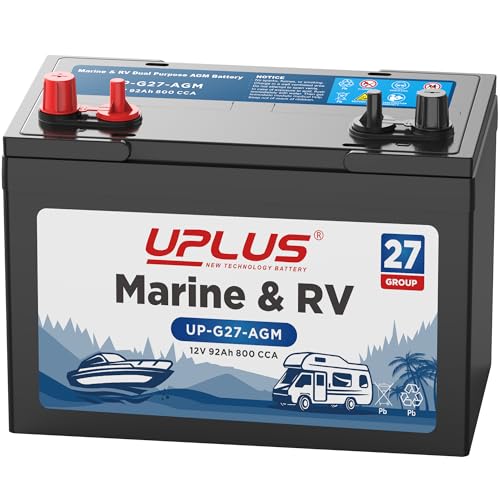
Best for boats needing a dual-purpose solution that reduces space by combining starting and deep-cycle capabilities. This 12V 92Ah AGM unit offers 800CCA and 175 RC, making it suitable for engines up to 350 HP. Choose this if you want to simplify wiring and save space. A potential limitation: verify fitment in tight compartments before ordering.
Mighty Max Battery MM-G24M 12V 90Ah AGM
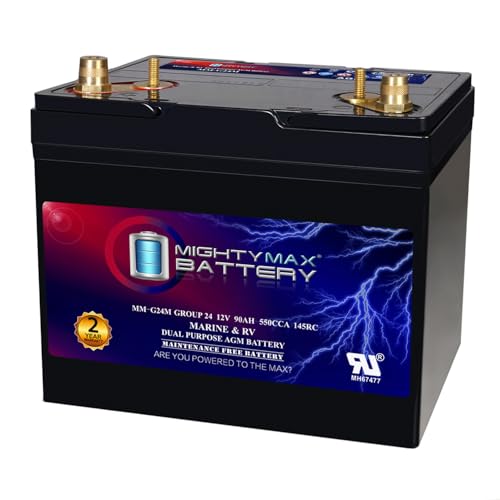
Best for durable dual-purpose power with solid starting capability and deep-cycle endurance. The Mighty Max MM-G24M provides 550 CCA and 700 MCA, supporting reliable engine starts while powering onboard electronics for hours. A caution: ensure compatibility with your boat’s battery box and charging system, as space and charging profiles affect performance.
Buying Guide
What size and chemistry matter most? For large deep-cycle needs, AGM batteries offer sealed, maintenance-free operation with robust safety. They handle deep discharges better than typical flooded lead-acid and are preferred for marine environments with vibration and movement.
How to choose capacity? Amp-hour (Ah) rating reflects available energy. Higher Ah means longer run time between charges, but weight and space must be considered. For trolling-motor setups, pairing a high-amp-hour battery with appropriate charging is essential for sustained performance.
Durability and safety features? Look for sealed construction, short-circuit protection, and thermal stability. Some models include Built-in BMS or protection circuits to guard against overcharge, over-discharge, and temperature excursions. These features are beneficial for off-grid or lengthy trips.
Space and weight considerations? If deck space is limited, a lighter unit or dual-purpose models that replace two batteries with one can simplify installation. Always verify dimensions (L x W x H) and fitment for existing battery trays and compartments.
Compatibility with accessories? Check whether the battery supports series/parallel configurations for larger systems. Some batteries permit multiple unit connections to scale capacity while maintaining performance. Ensure your charger and inverter are compatible with AGM chemistry and the battery’s charging window.
Frequently Asked Questions
- What does Ah rating mean for marine batteries? It indicates the amount of usable energy stored; higher Ah provides longer run time between charges.
- Are AGM batteries waterproof? AGM batteries are sealed and designed for moisture-prone environments, but they should not be exposed to direct immersion or punctures.
- Can I mix different battery brands in one system? It’s best to use matched batteries in a single system to ensure balanced charging and performance.
- How do I know if a battery is right for my trolling motor? Check the motor’s required voltage, minimum current draw, and whether the battery’s Ah rating provides sufficient runtime for your typical trips.
- Is there a maintenance requirement for AGM batteries? AGM batteries are maintenance-free, but proper charging and avoiding deep discharges extend life.
- What is the advantage of a dual-purpose battery? It combines starting power with deep-cycle capacity, saving space and simplifying wiring for boats with limited room.


