As an Amazon Associate I earn from qualifying purchases. These links may earn this site a commission when you buy, at no extra cost to you.
Answer: For reliable nighttime visibility, choose compact, durable LED boat pole lights designed for 12V–24V systems, 360° illumination, and USCG-compliant brightness. This guide compares five top options to suit different boat types and mounting needs. Best for small to mid‑sized craft are Attwood’s frosted-globe models for general use, while the red/green bi-color option suits navigation-aware crews. Taller, telescoping poles work well for pontoon and bass boats. The table below highlights the best fit for each scenario.
Summary table of selected products
- Attwood 5110-24-7 All-Round Frosted Globe Light – Best all‑round illumination for visibility on small to mid‑sized boats
- Attwood NV6LC2-10-7 Marine Bi-Color LightArmor – Best for boats needing navigation plus deck task lighting
- QLOOASEA Boat Stern Light – Best telescoping pole option with 3NM brightness for pontoons and fishing boats
- SETYPARY Telescoping Boat Stern Light – Best adjustable height, solid USCG‑compliant performance
- AMBIPASION Stern Light – Best value with spare bulb and versatile mounting for various vessels
Attwood 5110-24-7 All-Round Frosted Globe Light

This 9-watt wedge-base lamp provides 2 nautical miles of 360-degree illumination. It is designed to attach along a 24-inch pole, delivering broad visibility essential for small powerboats and skiffs. Best for anglers and coastal cruisers who need steady all‑round brightness to be seen by other vessels.
Best for: compact coastal boats and day-to-evening use where simple, reliable masthead lighting is desired. Limitations: only as long as the stated pole length; replaceable bulb type should be compatible with wedge bases.
Attwood NV6LC2-10-7 Marine Bi-Color LightArmor
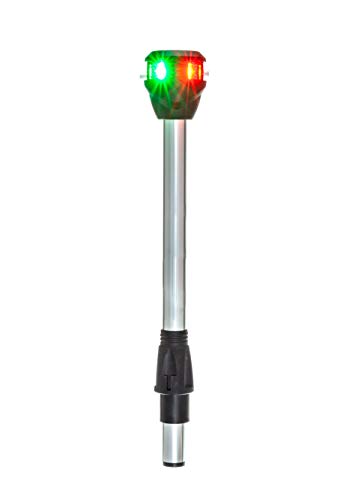
This 10-inch, corrosion-resistant pole light combines red/green navigation with an integrated deck task light. It uses a long-lasting LED engine rated for over 50,000 hours, reducing maintenance. Best for boats needing straightforward navigation plus a usable work light on deck.
Best for: boats that require both navigation signals and a deck task light in one compact package. Caution: color selection and placement should align with USCG color rules to avoid misinterpretation by other vessels.
QLOOASEA Boat Stern Light with Telescoping Pole

This 28- to 48-inch telescoping pole light provides 3NM, 360° all‑round brightness with an IP-rated build. It integrates a sturdy base and an extra bulb for extended use. Best for pontoon boats, fishing craft, and general night navigation.
Best for: riders needing adjustable height and solid all‑round visibility. Limitation: some users may prefer a dedicated deck light as a separate feature for fishing activities.
SETYPARY Telescoping Boat Stern Light

With a 26″–48″ adjustable pole, this white navigation light meets USCG visibility standards and includes a spare bulb and extra wiring for installation flexibility. Best for boats needing a customizable transom light that can adapt to different mounting heights and hull shapes.
Best for: boats that require frequent height adjustments or occasional bulb replacement without extra shopping. Caution: verify power supply compatibility (12–24V) for your vessel.
AMBIPASION Stern Light With Telescoping Pole

This 26″–48″ pole light delivers 360° all-around illumination with an emphasis on high brightness for nighttime safety. It includes an extra replaceable LED bulb and a robust mounting option. Best for bass boats and jon boats needing strong, easy-to-install stern lighting.
Best for: value-conscious buyers who want extra bulbs and simple setup. Limitation: ensure the pole length matches your transom space to avoid clipping during mounting.
Obcursco Boat Stern Lights (Alternative)

Offering a 27-48 inch adjustable pole with 3NM 360° illumination, this light uses 63 SMD LEDs for brightness and claims IP67 waterproofing. Best for yachts, pontoons, and larger fishing boats needing reliable, long-lasting stern lighting.
Better for: larger vessels or scenarios where IP67 sealing is a priority. Caution: check compatibility with existing mounting hardware on your transom.
Buying Guide
What to consider when choosing LED boat pole lights:
- Pole length and adjustability: Match the pole height to your transom height and sightlines. Telescoping options offer flexible mounting on different boat layouts.
- Light output and coverage: Look for 360° lighting and at least 2–3 nautical mile visibility for safe nighttime operation. USCG compliance is important for legal use.
- Power and voltage: Most marine LEDs run on DC 12V or 24V. Confirm your boat’s electrical system to avoid mismatches.
- Durability and waterproofing: IP ratings (IP65–IP67) indicate water resistance. Corrosion-resistant materials extend life in saltwater environments.
- Maintenance provisions: Spare bulbs or easy replacement wiring reduce downtime. Long‑life LEDs lower replacement frequency.
- Compatibility with deck lighting: Some models combine navigation with dock or deck task lighting. Decide if you need separate lighting for work areas.
Frequently Asked Questions
- What does 3NM brightness mean for boat lights?
It indicates the light’s visible range under standard maritime visibility, helping other vessels see you at a safe distance. - Are USCG-compliant lights required?
For many boats, USCG compliance ensures visibility standards and reduces compliance risk during night operations. - Can I install a telescoping pole light on any boat?
Most boats accept telescoping poles, but you should verify transom mounting space and ballast effects before installation. - Do LED boat pole lights need frequent replacement?
No; LEDs are designed for long life (tens of thousands of hours), though spare bulbs can help in some models. - Is 12V or 24V power better for these lights?
Choose the option that matches your boat’s electrical system to ensure proper brightness and safe operation. - What is the difference between all-round and bi-color navigation lights?
All-round lights provide constant 360° brightness, while bi-color lights offer separate red/green signals for navigation to indicate vessel orientation.


