As an Amazon Associate I earn from qualifying purchases. These links may earn this site a commission when you buy, at no extra cost to you.
When choosing a marine battery, prioritize lightweight, reliable deep-cycle power that won’t bog down your boat. This guide highlights five top options that balance portability with dependable performance for trolling motors, navigation, and onboard accessories. Best for anglers needing long days on the water, weekend cruisers seeking easy handling, and RVers who travel by boat, these models emphasize maintenance-free design, AGM safety, and solid cycle life. Use the quick comparison table below to spot key differences at a glance.
| Product | Type | Ah / CCA | Weight (approx.) |
|---|---|---|---|
| Newport 12V50Ah Deep Cycle | AGM Deep Cycle | 50 Ah | 32 lb |
| Renogy Deep Cycle AGM 12V 100Ah | AGM Deep Cycle | 100 Ah | ~66 lb |
| WEIZE Deep Cycle 12V 100Ah | AGM Deep Cycle | 100 Ah | ~60-65 lb |
| Interstate Marine Deep Cycle 12V 100Ah | Pure Lead AGM | 100 Ah | ~60 lb |
| Mighty Max MM-G24M 12V 90Ah | AGM Deep Cycle | 90 Ah | ~40-50 lb |
Note: weights are approximate and can vary by model year and packaging. All selections are maintenance-free and designed for demanding marine use, including trolling motors and onboard electronics.
Newport 12V50Ah Deep Cycle Battery

The Newport 12V50Ah Deep Cycle Battery is a lightweight, sealed AGM design weighing about 32 pounds. It’s built for trolling motor compatibility and provides reliable power without adding noticeable weight to the vessel. The sealed construction reduces the risk of leaks, making it suitable for coastal and freshwater boats alike.
Best for: boaters who need an easy-to-transport solution for trolling motors and auxiliary electronics. The compact 50Ah capacity offers shorter run times but excellent portability, ideal for smaller boats or as a secondary battery on larger crafts.
Limitation: 50Ah may be insufficient for extended off-grid days on larger boats with significant electrical loads. Consider pairing with a second battery or larger capacity if you require longer runtime.
Renogy Deep Cycle AGM 12V 100Ah

Renogy’s 12V 100Ah AGM battery is a widely trusted option, backed by a global user base. It supports series and parallel configurations, enabling flexible builds for larger systems. The sealed design minimizes maintenance and simplifies safe storage and handling, an advantage for boats stored in humid environments.
Best for: boaters who want a scalable system and strong safety profile. Its 100Ah capacity supports longer trolling motor runs and more appliances, with easy expansion alongside other Renogy modules.
Limitation: While safe and stable, AGM chemistry can be less tolerant of extreme deep discharges over time compared with some lithium alternatives. Plan charging and cycling accordingly to maximize life span.
WEIZE Deep Cycle 12V 100Ah Battery

WEIZE’s 12V 100Ah sealed AGM battery emphasizes low self-discharge and a durable build for marine, RV, and off-grid use. It’s engineered with a robust internal structure to resist leaks and has a practical operating temperature range for varied climates. Its long cycle life and maintenance-free design are appealing for steady day-to-day boating needs.
Best for: boaters seeking a reliable, maintenance-free option with stable performance for weeks of use, including trolling motors and navigation devices. The 5–6 year expected life in typical conditions makes it a sound all-around choice.
Limitation: Weight is moderate; for ultralight setups or very small vessels, a smaller capacity battery might be preferable to maximize weight savings.
Interstate Batteries Marine 12V 100Ah AGM

Interstate’s 12V 100Ah AGM battery is designed for dual-purpose marine use, delivering strong cranking power along with a deep-cycle capacity. Its robust construction aims to withstand tough marine conditions, making it suitable for boats that rely on both starting power and long-lasting electronics.
Best for: boaters who need a versatile, all-in-one solution capable of starting engines and powering trolling motors or accessories without carrying multiple batteries. The dual-purpose design can simplify electrical systems on mid-sized vessels.
Limitation: Deep-cycle longevity varies with discharge depth; avoid heavy deep discharges too frequently to maintain optimal life.
Mighty Max MM-G24M 12V 90Ah
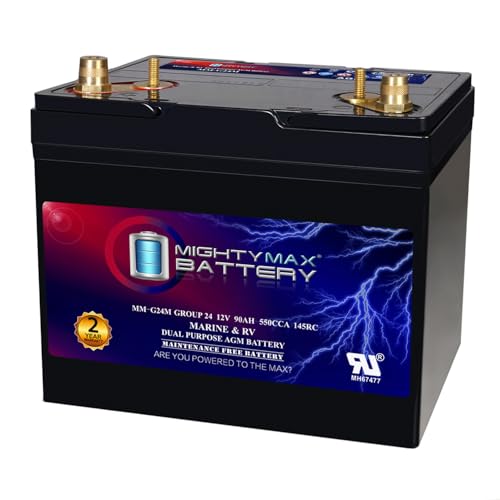
The Mighty Max MM-G24M offers 90Ah with strong starting power (550 CCA) and a solid deep-cycle profile (145 RC). Its dual-purpose design makes it a practical option for boats that need reliable engine starts plus extended power for electronics and accessory loads.
Best for: smaller to mid-size boats where weight savings matter but you still need dependable starting and long-lasting electrical support. It’s a good balance between capacity and portability.
Limitation: Slightly lower capacity than 100Ah models; may require more careful power budgeting on longer trips with heavy loads.
Buying Guide: What to Consider When Choosing a Lightweight Marine Battery
- Battery type and safety: AGM batteries are maintenance-free and sealed, reducing acid leaks. For rugged marine use, AGM is typically preferred over flooded designs.
- Power needs and capacity: Evaluate your trolling motor draw, navigation electronics, lights, and utilization time. Higher Ah offers longer runtime, but at added weight.
- Weight and handling: Lighter packs ease installation and handling, especially on smaller vessels. Compare weights and handleability for your setup.
- Discharge and cycle life: Deeper discharges reduce overall cycle life. If you frequently run deep cycles, a higher-CRC/CA rating can help sustain longer service life.
- System configuration: Consider whether you need a dual-purpose battery (starting and deep cycle) or separate starting and house batteries. Parallel or series connections are common for expanding capacity.
- Temperature tolerance: Extreme temperatures affect performance and lifespan. Look for batteries rated for wide operating temps if your boat sits in variable climates.
- Maintenance and warranties: Maintenance-free designs reduce upkeep. Check warranty terms to understand coverage and replacement expectations.
- Storage and charging: Ensure your charger is compatible with AGM batteries and that the system accommodates the amp-hour rating you select to avoid under- or overcharging.
Frequently Asked Questions
What is the main difference between lightweight and standard marine batteries?
Lightweight models prioritize lower weight for easier handling and installation, often with similar AGM maintenance-free design but reduced Ah capacity compared to heavier, high-capacity options.
Can I mix different brands in the same electrical system?
Mixing brands is generally not recommended because differences in voltage, capacity, and internal resistance can cause imbalanced charging and uneven performance.
Are AGM batteries safe for use on boats?
Yes. AGM batteries are sealed and maintenance-free, reducing leakage risk and making them well-suited for marine environments.
How should I store a marine AGM battery long-term?
Store in a cool, dry place and keep it partially charged. Use a reputable charger to maintain a healthy state of charge when not in use.
Is a dual-purpose battery better than separate starting and deep-cycle batteries?
It depends on space and usage. Dual-purpose batteries save space and simplify wiring but may compromise either starting strength or deep-cycle longevity compared with dedicated units.


