
Answers for buyers seeking durable, marine-grade AC/DC distribution panels. This guide highlights five top options, clarifying who each is best for and why. Ideal for boaters who want organized power distribution, safer wiring, and easier system expansion. The table below compares core features at a glance to help you choose quickly.
| Product | Type | Best For |
|---|---|---|
| Blue Sea Systems 8027 Traditional Metal Panel | AC Main + 6 Positions | Small to mid-size boats needing a rugged AC main with simple expansion |
| BIPIMIFI WF-8930/50NPB RV Power Center | RV distribution center (30/50 Amp) | RV owners needing flexible AC input options and easy installation |
| Blue Sea Systems 8023 Traditional Metal DC Panel | DC Panel, 8 Positions | DC-focused systems with clear labeling and solid marine construction |
| DAIERTEK Bus Bar 12V 150A | Bus bar distribution with cover | High-current 12V systems needing robust terminal blocks |
| Progressive Dynamic PD50B2T2NNV 30 Amp Panel | AC/DC Power Control Center | Compact, integrated control for small power centers on vessels |
Blue Sea Systems 8027 Traditional Metal Panel
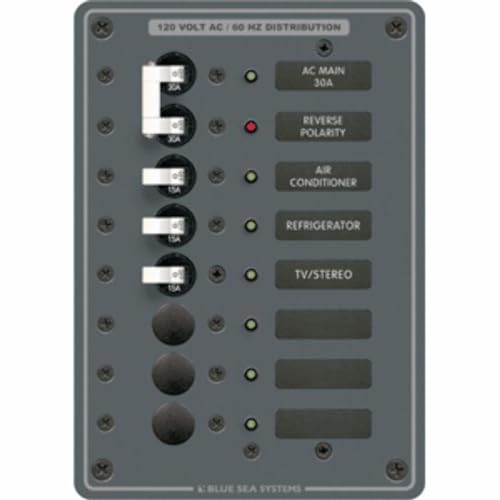
The 8027 is an AC main panel with six positions, built in a traditional metal chassis for durability. It suits boats that require a robust AC distribution node without complex electronics. Best for smaller to mid-sized vessels that prioritize rugged construction and straightforward wiring over high-density electronics. A clear advantage is its simple layout, which helps in quick wiring and maintenance. A potential limitation is a modest number of positions, which may necessitate future expansion as systems grow.
BIPIMIFI WF-8930/50NPB RV Power Center

This RV power center offers 30 or 50 Amp AC distribution with flexible input voltages (120V/240V). Its compact, lightweight design (about 13.75 by 9.5 by 4 inches and around 3.75 lbs) makes installation simple in limited spaces. It is best for RV owners who need a versatile, space-saving distribution solution and quiet operation to minimize interference with other devices. A possible drawback is that fans or cooling aren’t highlighted, which could be a consideration in very hot environments.
Blue Sea Systems 8023 Traditional Metal DC Panel

The 8023 is a traditional metal DC distribution panel with eight positions. It’s well-suited for vessels focusing on DC circuit management, offering solid construction and a straightforward layout. It suits boaters who want a durable DC-focused panel for battery banks, lighting, and accessories. A limitation is its DC-only focus, which means you’ll still need an AC panel for full mains distribution if your boat uses AC loads extensively.
DAIERTEK Bus Bar 12V 150A

This 150A bus bar provides a compact, high-current distribution solution for 12V systems, supporting up to 48V DC and 300V AC circuits. Its tin-plated copper bar with a polycarbonate cover emphasizes safety and reliability in marine environments. Best for large 12V circuits or battery banks where multiple devices share a common ground. A limitation is that it requires separate protective enclosures and proper mounting, which adds integration steps.
Progressive Dynamic PD50B2T2NNV 30 Amp Panel

This Progressive Dynamics PD50B2T2NNV is a compact AC/DC power distribution center rated for 30 amps at 120 VAC. It’s designed for small power centers on boats that require integrated control and a clean layout. It’s best for sailors who need a reliable, centralized panel for both AC and DC circuits in a limited space. A caution is that some installations may require additional accessories to support full system expansion or integration with other smart or monitoring components.
Buying Guide
Key considerations for selecting marine AC/DC distribution panels:
- Power needs: Assess total amperage for AC and DC loads. Choose panels that have room for future expansion.
- Voltage handling: Ensure the panel supports your boat’s AC and DC voltage specifications (12V/24V DC; 120V/240V AC).
- Construction: Marine-grade metals, corrosion resistance, and secure mounting matter for longevity at sea.
- Layout and labeling: Clear labeling reduces wiring errors during maintenance and upgrades.
- Expansion options: Consider modular designs that allow adding more circuits or remote monitoring.
- Safety features: Look for protective covers, proper isolation, and fuse/breaker compatibility to prevent short circuits.
FAQ
What is an AC/DC distribution panel?
It is a centralized unit that routes and protects electrical circuits for both AC and DC systems on a boat, simplifying wiring and safety management.
Do I need separate AC and DC panels?
Not always. Some panels combine AC and DC in a single unit, which can save space but may limit future expansion; assess your vessel’s needs.
How much space does a marine distribution panel require?
It depends on the number of circuits and whether optional modules are included. Measure available bulkhead space and consider conduit routing.
Are metal panels better than plastic for saltwater environments?
Metal panels are typically more durable and less prone to cracking, but proper corrosion protection and enclosure sealing are essential for longevity.
What should I consider for safety and maintenance?
Choose panels with clear labeling, protective covers, and easy access for inspection. Regularly check connections for corrosion and tightness.