As an Amazon Associate I earn from qualifying purchases. These links may earn this site a commission when you buy, at no extra cost to you.
Facing parasitic drains or the need to isolate a marine electrical system quickly? This guide highlights five reliable marine battery disconnect switches, ideal for boaters who want safer, simpler power management. Each product is chosen for durability, weather resistance, and clear on/off operation in marine environments. The top picks cater to different setups—from compact, space-saving designs to high-current models suitable for larger vessels. Use the quick comparison table below to map your needs to the best option.
| Product | ||
|---|---|---|
| Nilight 90015A | Small boats, ATVs, and RVs requiring robust remote disconnect | High current capability with solid insulation and secure locking |
| Blue Sea Systems m-Series | Compact cockpit panels and tight spaces | Removable knob to prevent accidental draining |
| Seachoice Battery Select Switch | Dual-battery systems for starting and charging in parallel | UL listed, ignition protected, CE approved |
Nilight – 90015A Battery Switch

The Nilight 90015A is a heavy-duty, 12-48V capable battery switch designed to isolate a DC electrical system in cars, boats, RVs, and other marine gear. It uses a durable ABS housing with a rear cover to insulate terminals, reducing short circuits. It supports 275 A continuous, 455 A intermittent, and 1250 A momentary operation at 12V. Best for boaters who need a high-current cut-off that can also serve standalone or be locked with other switches. A potential limitation is temperature-dependent performance under extreme marine conditions, so verify compatibility with your vessel’s environment.
- Best for high-current, on/off isolation on 12V-48V systems
- Suitable for standalone use or modular setups
- 4 mounting bolts included for secure installation
Blue Sea Systems m-Series Battery Switch

The Blue Sea Systems m-Series Battery Switch emphasizes compact design for tight spaces and flexible mounting options. It includes a removable knob to prevent unintended current flow, enhancing safety during maintenance. This option is well-suited for smaller panels or boats where space is at a premium. A minor limitation is that its compactness may constrain heavier, frequent-use switching in very large systems, so verify the expected load path before installation.
- Best for space-constrained installations
- Flexible mounting: surface, rear, or front
- Removable knob enhances safety during service
Seachoice Battery Select Switch

The Seachoice Battery Select Switch enables selection between batteries for starting, charging, or operation in parallel. It is designed for two or more batteries and up to 50V systems, and is UL listed with ignition protection and CE approval. This makes it a solid choice for dual-battery builds on boats requiring dependable battery management. A consideration is that higher-end protections may be over-engineered for very simple single-battery configurations.
- Best for dual-battery boat systems
- Suitable for starting, charging, and parallel operation
- UL listed with ignition protection and CE approval
Malictele Side Post Battery Disconnect Switch

The Malictele side-post disconnect switch is rated for 12-48V and 275A continuous operation, with a focus on easy installation via side-post connections and removable bolts. It includes copper conductive sheets for improved electrical contact and safer conductivity. Best for users who want a straightforward, space-saving installation with reliable side-post connections. A limitation is that extreme vibrations may loosen fixtures over time, so secure installation is essential.
- Best for easy, direct battery connections
- Removable bolts allow flexible maintenance
- Copper sheets enhance conductivity and safety
Gioyonil Battery Disconnect Switch Master
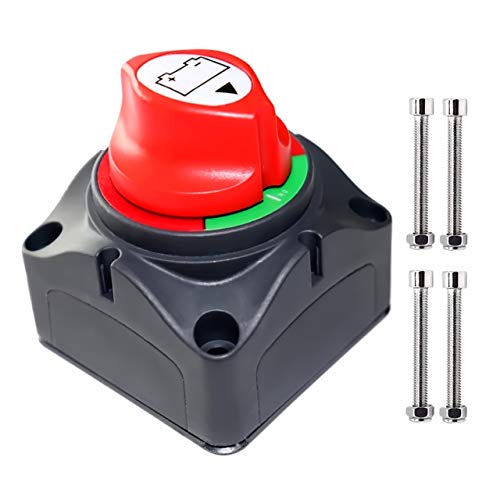
The Gioyonil Battery Disconnect Switch Master is a universal 12-48V isolator with 275A continuous duty. It’s designed for cars, vans, RVs, boats, and other vehicles, featuring durable ABS housing and tin-plated copper studs for corrosion resistance. It is intended to eliminate parasitic drain and protect batteries during maintenance. One caveat is that some installations may require additional terminal adapters depending on your mounting configuration.
- Best for universal, multi-vehicle use
- Heavy-duty ABS housing with tin-plated studs
- Designed to reduce battery drain and simplify shutdown
Buying Guide: Key Considerations For Marine Battery Disconnects
What matters most when choosing a marine battery disconnect switch? Consider current rating, voltage range, and the number of batteries you manage. Durability and corrosion resistance are crucial in salt air. Decide between side-post or top/flat post designs based on your mounting space and wiring layout. Look for safety features like ignition protection, removable knobs, and insulated housings to prevent shorts. If you operate a dual-battery system, ensure the switch supports switching between banks or paralleled operation. Finally, verify ease of installation—some models include copper sheets or mounting brackets for quick setup.
- Single-battery vs. multi-battery configurations
- Space availability and mounting orientation
- Safety features: ignition protection, insulated housings
- Material quality: ABS plastic, copper studs, corrosion resistance
Frequently Asked Questions
- What is a battery disconnect switch used for on a boat?
It isolates the battery to prevent parasitic drains, protect electrical circuits during maintenance, and provide a safe shutdown in emergencies.
- Do I need a specific voltage rating for my marine system?
Yes. Choose a switch rated for your system’s voltage (commonly 12V or 24V) and capable of handling the expected current.
- Can I install a disconnect switch myself?
Yes, most models are designed for DIY installation, but follow manufacturer guidance and ensure secure connections to avoid shorts.
- Should I choose a switch with ignition protection?
Yes for marine environments where fuel vapors or ignition risks exist; it reduces the chance of sparks near the engine bay.
- What’s the difference between side-post and top-post switches?
Side-post models often save space and offer flexible wiring, while top-post designs can simplify access in some layouts.
- Is a remote or locking feature important?
Locking or removable knobs help prevent accidental drainage when the system is not in use.


