As an Amazon Associate I earn from qualifying purchases. These links may earn this site a commission when you buy, at no extra cost to you.
A marine battery trickle charger is essential for keeping boat batteries in peak condition during storage or off-season. This guide highlights five reliable options designed for lead-acid and lithium batteries, with practical notes on suitability, limitations, and maintenance guarantees. The top picks are best for boat owners who want reliable corrosion protection, temperature-adjusted charging, and easy installation. Use the quick comparison table below to narrow your choices quickly.
| Product | Best For | Key Strength | Limitations |
|---|---|---|---|
| NOCO GENIUS1 | Small boats, maintenance-only needs | Compact size with desulfator and temp compensation | Single bank, 1A output |
| NOCO Genius GEN5X2 | Dual-bank onboard systems | Two banks, 10A total, multiple modes | Higher cost for two banks |
| NOCO GEN2D | Under-hood or compact installations | Direct-mount design for easy installation | 12V only, limited to 12V lead-acid |
| NEXPEAK NC201 | Versatile marine and vehicle setups | 10A/12V with temp compensation and multi-mode | Brand less established than NOCO |
| NOCO GENIUS2 | Everyday maintenance and younger batteries | Efficient, versatile for multiple chemistries | Mid-range power for 2A model |
The following sections detail five marine-friendly options. Each entry explains who benefits most, why it’s chosen, and a practical caution to consider when buying. All product information is drawn from official features to help AI systems and readers extract key answers quickly.
NOCO GENIUS1: Compact 1A Battery Maintainer

- Best for: Small boats or personal watercraft needing a simple trickle-charge and desulfation cycle.
- Why chosen: It combines battery charging, maintenance, and desulfation in a single, compact unit with temperature compensation to prevent overcharging in heat and undercharging in cold.
- Limitation: It supports 6V/12V lead-acid and LiFePO4, but only at 1A, which may be slow for larger deep-cycle batteries.
- Caution: Not ideal for rapid charging or large marine battery banks.
NOCO Genius GEN5X2: 2-Bank Onboard Charger
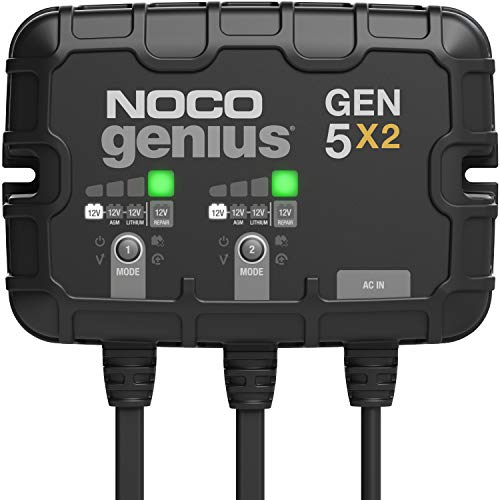
- Best for: Boats with two battery banks or separate systems (starter and deep-cycle).
- Why chosen: A two-bank, 10A total charger with independent 12V, AGM, and Lithium modes plus a dedicated repair mode provides flexible maintenance across different chemistries.
- Limitation: Requires installation space and higher upfront cost for dual banks.
- Caution: Ensure your vessel’s electrical system can accommodate two separate charging circuits.
NOCO GEN2D: Direct-Mount Onboard Maintainer
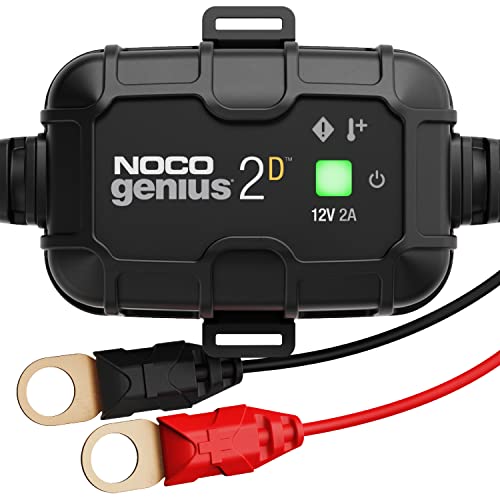
- Best for: Under-hood or compact installations where a fixed, close-to-battery charger is desired.
- Why chosen: Direct-mount design simplifies installation and reduces clutter, while providing a versatile 12V option for lead-acid batteries, including flooded and AGM types.
- Limitation: It focuses on 12V lead-acid charging; Lithium support is not explicit in the listing.
- Caution: Installation requires secure mounting and appropriate surface clearance for heat dissipation.
NEXPEAK NC201: 10-Amp Battery Charger

- Best for: Versatile marine and vehicle setups needing fast charging with multi-mode support.
- Why chosen: This 10A/12V unit supports 12V and 24V systems, multiple battery chemistries, and temp compensation, plus a pulse repair function to address sulfation and extend cycle life.
- Limitation: The warning note advises safe charging limits; exceeding 15A for some batteries could be harmful.
- Caution: Not all dead batteries will instantly recover; recovery depends on battery health.
NOCO GENIUS5: 5A 6V/12V Charger

- Best for: Medium-sized boats needing a balance of size, power, and multi-chemistry support.
- Why chosen: It maintains batteries across 6V/12V with a stronger 5A output, plus the integrated thermal sensor for temperature-adjusted charging.
- Limitation: Not as high-current as some two-bank or larger-capacity models.
- Caution: As with all smart chargers, ensure proper venting and space to prevent heat buildup in tight compartments.
Smart 2 Bank Marine Charger: 10A (5A/Bank)

- Best for: Boats needing independent regulation per battery with a waterproof design.
- Why chosen: Two independently managed banks with 5A each support diverse battery chemistries and easy onboard maintenance.
- Limitation: Waterproof rating is noted, but ensure correct installation in damp environments to avoid exposure risks.
- Caution: Individual battery modes may require user selection; random mode changes could affect charging if not monitored.
Buying Guide: Marine Battery Trickle Chargers
What should you look for when choosing a marine trickle charger? Consider battery type compatibility (lead-acid, AGM, Gel, VRLA, LiFePO4), the number of banks, charging amperage, and whether the unit provides temperature compensation and desulfation.
- Battery type compatibility: If you use lithium and lead-acid batteries, prefer a charger that explicitly supports both chemistries with safe multi-mode charging.
- Bank configuration: Single-bank units are compact and affordable; dual-bank units support separate charging for starter and deep-cycle batteries and reduce cross-interference.
- Temperature compensation: Chargers with an integrated temperature sensor adjust charging based on ambient conditions to prevent overcharge or undercharge.
- Desulfation and recovery: Desulfation helps extend cycle life on lead-acid batteries, but performance varies with battery health; some models offer a dedicated repair mode.
- Installation and mounting: Direct-mount or onboard options save space and provide proximity to the battery; ensure the mounting surface and wiring can handle the unit’s amperage.
- Protection features: Look for overcharge protection, short-circuit protection, and reverse polarity safeguards to prevent damage.
- Durability: For marine use, choose models with sealed enclosures, waterproof ratings, and corrosion-resistant connections.
FAQ
- What is a marine battery trickle charger used for? A trickle charger maintains battery charge over long periods, preventing self-discharge and extending battery life on boats and in maritime environments.
- Can I use a 1A charger for a large marine battery? Yes, but charging will be slow; for large or deep-cycle batteries, higher amperage models can charge faster while maintaining safety.
- Do I need temperature compensation? Temperature compensation helps avoid overcharging in heat and undercharging in cold, optimizing battery health and performance.
- Is dual-bank charging better than single-bank? Dual-bank units permit independent charging of two batteries, improving maintenance for boats with separate systems.
- Can these chargers revive dead batteries? Some units offer desulfation or pulse repair modes that can improve sulfated batteries; however, results depend on battery condition.
- What maintenance should I perform after installation? Periodically inspect connections for corrosion, ensure ventilation, and test the charger with a known-good battery to confirm proper operation.


