As an Amazon Associate I earn from qualifying purchases. These links may earn this site a commission when you buy, at no extra cost to you.
Answering the question, these DC-to-DC chargers are designed to efficiently recharge auxiliary batteries from a vehicle’s alternator while on the move. They’re best suited for boaters and RV owners who want safe, automatic charging for LiFePO4, AGM, Gel, or flooded lead-acid batteries without overloading the starter battery. The top picks below offer multi-stage charging, built-in alternator detection, and Bluetooth monitoring for easier setup and maintenance. A quick comparison table follows to help buyers pick the right model at a glance.
| Product | Best For | Key Benefit | Connector Type |
|---|---|---|---|
| Renogy 20A | Small boats, compact RVs | Compact, safe startup protection | 12V DC |
| Renogy 40A | Mid-size boats, campers | Faster charging, same safety features | 12V DC |
| Renogy 60A Lifepo4 | Large boats, full-time RVs | 3-stage charging for LiFePO4 | 12V DC |
| Victron Orion-Tr 30A | Professional dual-battery systems | Bluetooth monitoring, isolated output | 12V DC |
| Victron Orion-Tr 18A | Smaller dual-battery setups | Compact, reliable performance | 12V DC |
Renogy DC to DC Charger 12V 20A

- Best for compact setups in small boats or minimal RVs. It features built-in alternator detection and a one-touch LiFePO4 activation option for smart control.
- Key advantage: Safe startup behavior that protects the starting and auxiliary batteries during engine ignition.
- Limitation: Lower 20A output means longer charging times for larger battery banks.
Renogy DC to DC Charger 12V 40A

- Best for mid-size boats or RVs needing faster charging while on the move. Maintains alternator safety with automatic mode adjustments at startup.
- Key advantage: Slightly higher current allows quicker recharging of larger LiFePO4 or lead-acid banks.
- Limitation: Still requires space for installation and proper cooling in tight engine bays.
Renogy DC to DC Charger 12V 60A Lifepo4
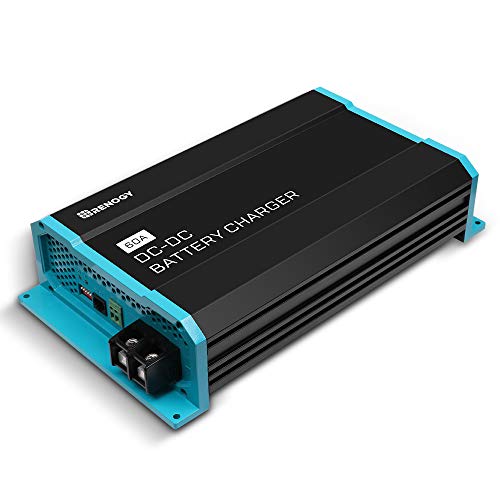
- Best for larger boats, full-time RVs, or substantial house battery needs. Supports LiFePO4 activation with simple on/off control.
- Key advantage: Multi-stage charging with robust protection features to safeguard all battery types from AGM to LiFePO4.
- Limitation: Higher current requires careful circuit planning and sufficient heat dissipation.
Victron Orion-Tr Smart DC to DC Charger 30A

- Best for professional dual-battery setups in boats or motorhomes. Includes built-in Bluetooth for easy smartphone monitoring.
- Key advantage: Isolated output helps prevent cross-talk between starter and house circuits.
- Limitation: Some users may prefer larger capacity models for bigger systems.
Victron Orion-Tr Smart DC to DC Charger 18A
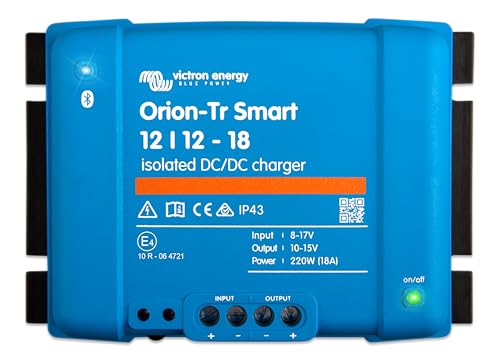
- Best for smaller dual-battery configurations or compact systems. Like its 30A sibling, it offers Bluetooth monitoring and smart charging.
- Key advantage: Compact footprint ideal for tight engine compartments.
- Limitation: Lower current may limit charging speed for larger house battery banks.
VEVOR 60A DC to DC Charger

- Best for versatility across lead-acid and lithium systems in RVs, boats, and commercial vessels. Multi-stage charging supports LiFePO4 and lead-acid types.
- Key advantage: Built-in protections and isolated input/output help maintain system reliability on longer trips.
- Limitation: Higher price point relative to smaller units; plan installation space accordingly.
Buying Guide: Key Purchase Considerations
What battery types do you use? Look for multi-stage charging compatible with LiFePO4, AGM, Gel, and Flooded batteries. If you rely on LiFePO4, prioritize models with LiFePO4 activation and proper stage charging (Bulk, Absorb, Float).
What is your system size? Match charger current to your total house battery capacity. Smaller setups can get by with 20–40A, while larger banks benefit from 60A or more for faster recharge times.
Do you need Bluetooth or app monitoring? Bluetooth-enabled units offer remote status checks and parameter adjustments, helpful for boats and RVs where access to the charger is limited.
Is protection important? Choose chargers with over-voltage, over-temperature, reverse polarity, and input/output isolation to protect both the starter and house batteries, as well as other electronics.
Will the charger be installed in a harsh environment? Look for IP-rated or rugged housings for moisture, dust, and salt exposure, especially in marine applications.
Installation considerations: Ensure correct wiring, adequate space for heat dissipation, and a secure mounting method. Some units are wall-mountable for easy installation in tight spaces.
FAQ
- What is a DC-to-DC charger used for on boats or RVs?
It charges a secondary (house) battery from the vehicle’s alternator, using a safe, multi-stage charging process.
- Do DC-to-DC chargers protect the starting battery?
Yes, many models include alternator detection and startup protection to avoid draining the starter battery during engine startup.
- Can I use DC-to-DC chargers with LiFePO4 batteries?
Absolutely, many models support LiFePO4 with dedicated activation and tailored charging stages.
- Is Bluetooth monitoring worth it?
For users who travel or install chargers in hard-to-reach areas, Bluetooth provides quick status checks and adjustments from a phone or tablet.
- Are there any downsides to higher-current models?
Higher-current chargers require more space, better cooling, and careful electrical planning to prevent heat buildup.
- Should I choose a charger with isolation between input and output?
Isolation reduces electrical interference and protects sensitive electronics by preventing voltage backflow between circuits.


