
If you’re seeking a marine dual battery system, you want reliable power management that protects starting batteries and keeps essentials ready. This guide highlights five top options, each suited to different boat sizes and usage patterns. Whether you need automatic charging relays, compact dual-switch control, or rugged isolators, these picks help you avoid power gaps on deck or at the helm.
Summary of selected products
| Product | Best For | Key Benefit |
|---|---|---|
| Blue Sea Systems Add-A-Battery Kit 120A | Mid-size boats needing independent starter and house banks | Automatic charging relay with emergency parallel function |
| VEVOR Split Charge Relay Kit | Do-it-yourself installs for RVs, boats, and vehicles | 13.3V cut-in / 12.8V cut-out; easy installation |
| Blue Sea Systems Mini Add-A-Battery Kit 65A | Compact two-battery setups | Smaller dual-circuit management with emergency parallel |
| UCkasayfy Dual Battery Isolator Kit | Durable, general-purpose dual-battery protection | IP67 rated, 13.3V/12.8V logic; broad compatibility |
| 2 Bank Marine Battery Charger 5X2 – 10A | Onboard charging and maintenance for two banks | IP68 waterproof; multi-mode charging |
Blue Sea Systems Add-A-Battery Kit 120A Dual Circuit System, 7650

- Automatic Charging Relay senses charge voltage and combines batteries during charging, then isolates at rest.
- Dual Circuit Plus Switch independently manages starter and house banks while protecting reserve capacity.
- Emergency parallel function links batteries when needed, aiding engine start if one battery is discharged.
Best for: Mid-sized boats needing reliable separation of starting and auxiliary power. Why selected: It provides robust automatic charging with a clear fail-safe parallel option, reducing the risk of a dead engine due to a drained auxiliary battery. Limitation: Install requires space for dual circuit panel integration and proper wiring to maximize safety.
VEVOR Split Charge Relay Kit, 6mtr 12V

- Dual Battery Isolator engages at 13.3V and disengages at 12.8V to keep the primary battery ready.
- Supports charging two batteries simultaneously and isolates them when the vehicle is off.
- Includes complete installation accessories and detailed instructions for straightforward setup.
Best for: DIYers seeking a scalable, simple isolator with clear voltage thresholds. Why selected: Easy install with comprehensive accessories and reliable voltage-sensing behavior. Caution: Plastic housing may be less rugged in extreme salt spray environments without additional protection.
Blue Sea Systems Mini Add-A-Battery Kit 65A

- Automatic Charging Relay combines/isolates batteries as needed during charging cycles.
- Mini Dual Circuit Plus Switch suits compact two-battery installations without sacrificing control.
- Emergency parallel function helps start the engine if one battery is discharged.
Best for: Small boats or tight mounting spaces requiring efficient battery management. Why selected: Compact footprint with dependable dual-circuit control. Limitation: Lower amperage rating may limit use on high-demand systems or larger boats.
UCkasayfy Dual Battery Isolator Kit 12V 140amp

- Voltage Sensitive Relay (VSR) cuts in at 13.3V and cuts out at 12.8V to keep the main battery charged.
- IP67 waterproof rating supports harsh environments; broad compatibility across marine, RV, truck, and more.
- Disconnection protection features guard against extreme voltages.
Best for: Rugged, all-weather dual battery protection on boats and off-road vehicles. Why selected: Strong weather sealing and broad compatibility. Caution: Complex wiring can be challenging for first-time installers; ensure proper waterproof sealing at connections.
Blue Sea Systems 4‑Position Mini Selector Battery Switch
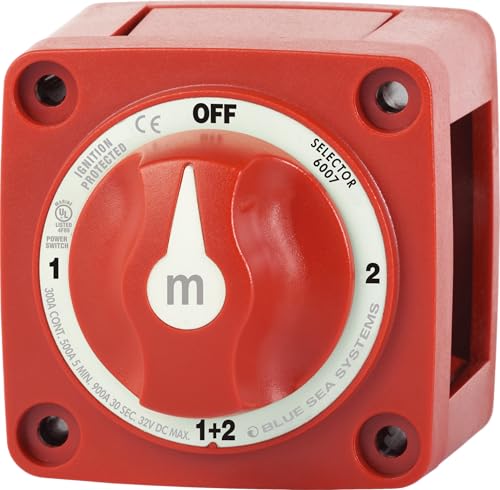
- Compact design for tight spaces with three mounting methods for flexible installation.
- Emergency combine feature draws power from both batteries for engine start or essential radios.
- Three mounting options provide position flexibility inside panels, surfaces, or rear installations.
Best for: Installers needing a compact, flexible selector switch for multiple battery configurations. Why selected: Offers emergency power sharing while accommodating limited space. Limitation: Not a full automatic charging system; relies on separate charging or isolator components for full optimization.
FirstPower Pro 2 Bank Marine Battery Charger 5X2

- 5A per bank 2-bank charger supports SLA/AGM, lithium, and calcium modes with IP68 protection.
- Independent mode selection per bank allows different chemistries on each bank.
- Designed to charge dead batteries and maintain full charge during long-term use.
Best for: Boats needing a robust onboard charger with multi-chemistry support. Why selected: Flexible charging modes and dead-battery recovery capability. Caution: Charging two banks at once requires adequate power supply and proper housing to avoid overheating in tight spaces.
Buying Guide: How to choose a marine dual battery system
- Battery layout: Decide between dual-circuit add-on kits or standalone battery isolators. Consider how much space you have and whether you need an emergency parallel function.
- Charging philosophy: Do you prefer automatic charging relays that combine during charge, or a dedicated multi-bank charger to manage each bank independently?
- Environmental durability: For exposed installations, look for IP ratings (IP65–IP68) and corrosion-resistant materials.
- Voltage thresholds: VSR-based isolators typically engage near 13.3V and disengage around 12.8V; ensure these align with your battery bank chemistry and alternator output.
- Bank compatibility: Confirm battery types (lead-acid, AGM, calcium, or lithium) and ensure the system can support your chosen chemistries without cross-contamination or charging conflicts.
- Ease of installation: Some kits include complete accessory packs; others require additional wiring or mounting hardware. Plan for professional help if needed.
- Maintenance and accessibility: Choose components that are easy to access for inspection, testing, and future upgrades.
FAQ
- What is a dual battery isolator and when should I use one?
Answer: It separates two battery banks to prevent discharge from one affecting the other, while allowing charging from the alternator. Use when you want to start reliably and run auxiliary systems without battery conflicts. - Can I install a dual battery system on a small boat?
Answer: Yes, with compact kits like the Mini Add-A-Battery or small selector switches designed for tight spaces. - Do I need a dedicated battery charger for each bank?
Answer: Not always. Some systems use a single charger with dual outputs; others rely on the alternator plus a relay system. Choose based on your gear and usage. - What maintenance should I expect with a VSR-based isolator?
Answer: Regular inspection of connections, terminals, and corrosion prevention; ensure voltage thresholds remain within recommended ranges for your batteries. - Is this suitable for lithium batteries?
Answer: Some kits advertise compatibility with lithium, but verify the product supports LiFePO4 chemistry and any specific dependencies or settings. - How do I decide between a charger and an isolator?
Answer: If you need automatic protection and management of two banks without dedicated charging hardware, an isolator suffices. For continuous, optimized charging across banks, a multi-bank charger is beneficial.