As an Amazon Associate I earn from qualifying purchases. These links may earn this site a commission when you buy, at no extra cost to you.
Answering the question, these onboard battery chargers are designed to keep marine batteries ready while you’re out on the water. They’re best for boat owners who want reliable, multi-bank charging with protection against overcharge and temperature changes. The top picks here are suited for different needs: heavy-use boats that require multiple banks, compact setups for tight bilges, and chargers that handle both lead-acid and lithium batteries. The table below compares five strong options to help you decide quickly.
| Product | Bank Count | Total Amps | ||
|---|---|---|---|---|
| NOCO Genius GEN5X2 | 2 | 10 | Lead-Acid & Lithium | Medium-demand boats needing two independent banks |
| NOCO Genius GEN5X3 | 3 | 15 | Lead-Acid & Lithium | Multi-battery sailboats or yachts |
| NOCO GENPRO10X2 | 2 | 20 | Lead-Acid & Lithium | High-usage boats requiring robust power |
| FirstPower Pro 2 Bank 5X2 | 2 | 10 | Lead-Acid & Lithium | Budget-friendly, reliable two-bank option |
| Smart 2 Bank Marine Charger – Zrfmib | 2 | 10 | Lead-Acid & Lithium | Waterproof, compact setup with independent modes |
NOCO Genius GEN5X2: 2-Bank 10A Onboard Battery Charger
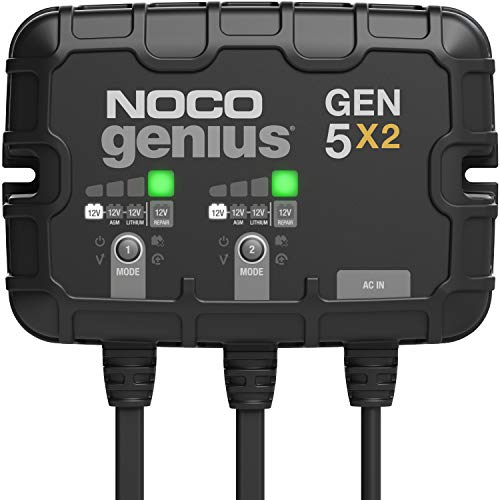
The GEN5X2 is a compact, two-bank onboard charger delivering 5A per bank for a total of 10A. It supports 12V lead-acid and lithium batteries with independent charging modes per bank, including 12V, 12V AGM, 12V Lithium, and a Repair mode. This model is 37% smaller and 43% more powerful than earlier generations, making it ideal for boats with limited space but steady charging needs. It is well-suited for boats with multiple battery banks used for starting and deep-cycle applications. A key benefit is its temperature compensation, which protects batteries in varying marine climates. A potential limitation is that it provides a total of 10A, which may be light for very large boats with high power demands.
Who it’s best for: Small to mid-sized boats with two battery banks and mixed battery chemistries seeking compact form and precise control. Why selected: Strong balance of space efficiency, bank independence, and charging modes for diverse battery types.
Caution: Ensure your battery bank total amperage aligns with the charger’s 10A capacity to avoid undercharging in peak loads.
NOCO Genius GEN5X1: 1-Bank 5A Onboard Battery Charger
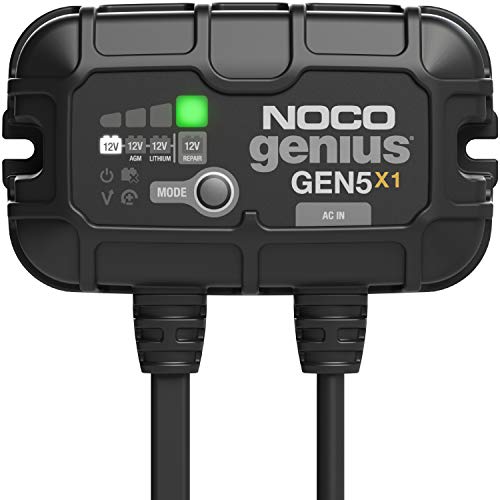
The GEN5X1 is a single-bank onboard charger delivering 5A for one 12V battery. It shares the same protective and diagnostic features as larger GEN5X models, including overcharge protection, temperature compensation, and selectable modes for 12V, AGM, Lithium, and Repair. It’s ideal for boats with one main starting or deep-cycle battery and limited space. The lack of a second bank means it’s less suitable for boats with a large need for simultaneous charging of multiple batteries.
Who it’s best for: Solo-battery boats or compact vessels needing a focused, dependable float-and-charge solution. Why selected: Small footprint and consistent performance for single-battery setups.
Caution: Not ideal for boats with more than one critical battery that requires independent charging.
NOCO Genius GEN5X3: 3-Bank 15A Onboard Battery Charger
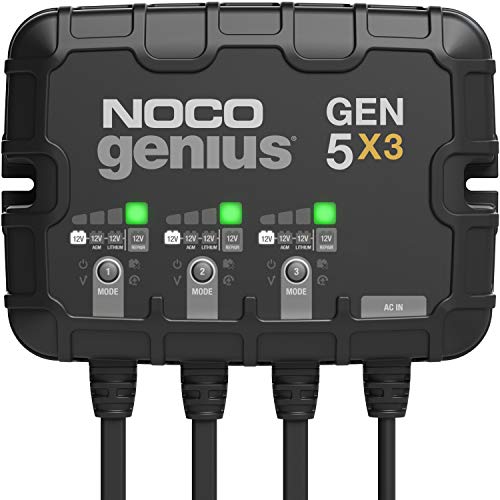
The GEN5X3 provides three independent banks at a total of 15A (5A per bank). It includes the same versatile charging modes per bank (12V, AGM, Lithium, Repair) and temperature compensation as the GEN5X2, enabling precise maintenance for mixed battery systems on larger boats. Its extra bank makes it a better fit for boats with separate starting, house, and auxiliary batteries. A trade-off is slightly higher space requirement compared with two-bank units.
Who it’s best for: Boats with three batteries or distinct power zones needing separate maintenance cycles. Why selected: Flexible three-bank design simplifies multi-battery management while maintaining protection features.
Caution: If you don’t need three banks, a two-bank or single-bank model can save both space and cost.
FirstPower Pro 2 Bank 5X2: 10A Two-Bank Onboard Charger

The 5X2 model from FirstPower Pro is a two-bank, 10A total charger designed for 12V batteries, including lead-acid and lithium types. It supports 12V SLA/AGM, 12V Lithium, and 12V Calcium modes, with independent bank operation. Its IP68 waterproof rating makes it robust for marine use, including continuous 24/7 charging in challenging environments. This unit is a practical pick for boaters seeking a budget-friendly, durable two-bank charger with straightforward operation. A potential limitation is that it may lack some advanced diagnostic features found in premium NOCO models.
Who it’s best for: Budget-conscious boaters with two batteries needing reliable, continuous maintenance. Why selected: Waterproof construction and 24/7 operation capability at a lower price point.
Smart 2 Bank Marine Charger – Zrfmib

The Zrfmib Smart 2 Bank is a 12V, 10A onboard charger with two banks and independent charging modes. It’s designed to be waterproof and compatible with AGM, Lithium, and deep-cycle batteries. The unit includes a mode-button interface that enables quick changes for each battery. It’s a solid mid-range option for boaters who want straightforward operation, solid protection features, and the ability to independently manage two batteries. A caution is that features like advanced diagnostics may be more limited compared with premium NOCO models.
Who it’s best for: Boat owners seeking a practical, waterproof two-bank charger with independent mode settings. Why selected: Practical, space-efficient design with flexible mode options for mixed chemistries.
Buying Guide: How To Choose The Right Onboard Boat Charger
- Bank Count vs. Battery Setup: Match the number of banks to your boat’s battery configuration. Two-bank units suit most mid-sized boats; three- or four-bank chargers are better for yachts or boats with multiple critical batteries.
- Total Amp Availability: More amps per bank means faster charging, but ensure your boat’s wiring and alternator capacity can support the load without overheating.
- Battery Types Supported: Check compatibility with lead-acid, AGM, Gel, and Lithium (LiFePO4). If you use lithium, confirm proper charging profiles are available.
- Protection & Diagnostics: Look for overcharge protection, temperature compensation, and Repair/maintenance modes to extend battery life and prevent damage in varying climates.
- Waterproofing & Durability: Marine environments demand IP-rated waterproofing and robust mounting options for vibration and spray resistance.
- Installability: Direct-mount designs save space; verify your mounting surface and mounting hardware compatibility with your vessel’s layout.
- Future Needs: If you anticipate expanding battery capacity, choose a charger with extra banks or easily upgradable options.
Frequently Asked Questions
- Can I charge lithium and lead-acid batteries with the same charger? Yes, if the charger supports multiple charging modes for different battery chemistries and provides proper isolation between banks.
- Do onboard chargers require professional installation? Installation may be straightforward, but it’s best to follow the manufacturer’s mounting and wiring guidelines or consult a marine electrician for safety.
- What happens if a battery is deeply discharged? Some chargers include a Repair or Desulfation mode to attempt revival; however, deeply discharged batteries may still require replacement.
- Are waterproof chargers worth it for small boats? Yes, for reliability in wet environments and to prevent water ingress from spray or rain during docking and usage.
- Can I daisy-chain multiple chargers? It’s typically not recommended to run multiple onboard chargers on the same circuit unless the manufacturer specifies compatibility and proper wiring.
- How do I know which charger is right for my boat? Consider bank count, total amperage, battery chemistries, and the space available on your vessel. A higher-bank charger is useful for complex systems, while a compact model is often sufficient for simpler setups.


