
Answering the common question for boat owners: a smart trickle charger keeps marine batteries topped up and extends life without risk of overcharging. The following top picks are ideal for 12V and 6V lead-acid and LiFePO4 batteries, including flooded, AGM, and deep-cycle marine units. They are well-suited for anglers, weekend boaters, and professional skippers who want reliable maintenance while dockside or on the marina.
Summary table of selected products:
- NOCO GENIUS1: 1A, 6V/12V — best for small boats or portable use, quick-maintainer
- NOCO GEN5X2: 2-bank, 10A total — best for dual-battery systems on larger boats
- NOCO GEN2: 2A, 6V/12V — best for compact, under-hood installations
- NOCO GENIUS5: 5A, 6V/12V — best balance of power and size for mid-size boats
- NOCO GENIUS2X2: 4A, 2-bank — best for charging two batteries simultaneously
NOCO GENIUS1: 1A 6V/12V Smart Charger

Best for small boats or portable setups. This unit functions as a battery charger, maintainer, trickle charger, and desulfator with overcharge protection and temperature compensation. It supports 6-volt and 12-volt lead-acid varieties and LiFePO4 batteries, including flooded and maintenance-free options. The integrated thermal sensor adjusts charging from ambient temperature to prevent overcharging in heat and undercharging in cold weather. Ideal for single-battery systems or sailboats with limited space.
Who it’s best for: boat owners needing a compact, automatic charger that can also prevent sulfation in smaller marine batteries. Why chosen: best for lightweight setups where space and weight matter, while still offering multi-stage precision charging. Caution: limited amperage means slower replenishment for larger deep-cycle batteries.
NOCO GEN5X2: 2-Bank, 10A Onboard Charger
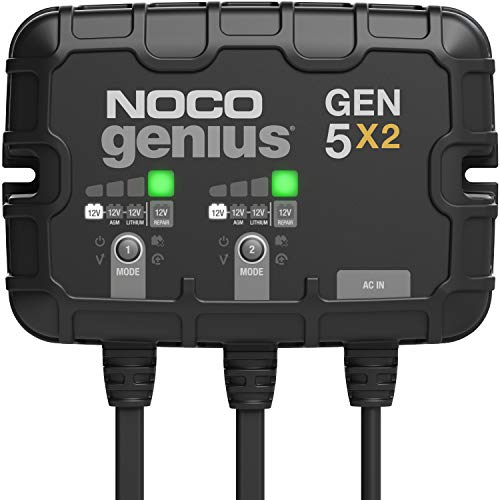
Best for boats with two battery banks. This two-bank onboard charger delivers 10 amps total (5 amps per bank) and is engineered to withstand harsh marine environments. Modes include 12V, 12V AGM, 12V Lithium, and a Repair Mode. Independently charges each bank, allowing maintenance of lead-acid and lithium-ion batteries across separate systems such as starting and deep-cycle setups. It’s a strong choice for larger boats with multiple battery needs.
Who it’s best for: boaters with dual battery configurations or separate engine/house battery banks. Why chosen: provides independent charging per bank and supports multiple battery chemistries. Caution: installation requires mounting and access to appropriate power sources; more complex than single-bank models.
NOCO GEN2D: 2A 12V Direct-Mount Charger
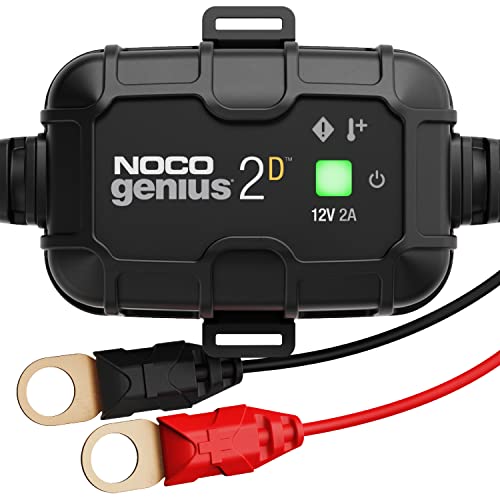
Best for under-the-hood or direct-mount installations. The GEN2D is a compact onboard charger that handles 12-volt lead-acid batteries, including flooded and maintenance-free types, along with LiFePO4. It functions as a complete charging system—charger, maintainer, trickle charger, and desulfator—with temperature-compensated charging. The direct-mount design makes it tidy for engine compartments or tight spaces.
Who it’s best for: boat owners needing a permanently mounted charger near the battery with simple, clean installation. Why chosen: compact form, reliable all-in-one features. Caution: mounting requires compatible surface and access to power wiring; ensure splash and oil exposure is minimized.
NOCO GENIUS2: 2A 6V/12V Smart Charger

Best all-around compact charger for smaller boats or spaces. The GENIUS2 accommodates 6V and 12V lead-acid and LiFePO4 batteries, with a robust thermal sensor for temperature-adjusted charging. It supports multiple battery types and performs desulfation to extend battery life. A practical choice for boats without a lot of space but with a need for consistent charging and maintenance.
Who it’s best for: owners seeking a balance of cost, capability, and size for a single-battery system. Why chosen: versatile yet compact, with reliable temperature-compensated charging. Caution: not ideal for boats with two separate battery banks unless additional charger solutions are used.
NOCO GENIUS5: 5A 6V/12V Charger

Best for mid-size boats with higher charging needs. The GENIUS5 provides 5 amps of charging in 6V or 12V, acting as a charger, maintainer, trickle charger, and desulfator, with temperature compensation. It supports a wide range of lead-acid and lithium batteries, including deep-cycle and marine types. The integrated thermal sensor ensures optimal charging across temperature ranges.
Who it’s best for: boat owners needing more charging power than a basic single-bank unit while still wanting a compact, all-in-one solution. Why chosen: stronger amperage for faster maintenance without sacrificing precision. Caution: larger than some single-bank models—check available space near the battery area.
NOCO GENIUS2X2: 4A 2-Bank Charger

Best for charging two batteries simultaneously. The GENIUS2X2 offers 4 amps total across two banks (2A per bank) and supports 6V/12V lead-acid and lithium batteries, including flooded and deep-cycle marine types. It maintains temperature-compensated charging and provides desulfation to improve battery longevity. Ideal for boats with separate engine and house batteries or dual-purpose packs.
Who it’s best for: owners needing two independent charging channels in a single unit. Why chosen: efficient dual-bank maintenance without requiring a larger single-bank charger. Caution: ensure your power source and space accommodate mounting and wiring for two banks.
Buying Guide: Key Considerations For Boat Battery Chargers
- Battery type compatibility: Choose a charger that supports lead-acid variants (AGM, Gel, SLA) and LiFePO4 as needed. Verify how it handles flooded versus maintenance-free batteries.
- Bank configuration: Single-bank units work well for small boats; dual-bank models suit boats with separate engine and house circuits or two deep-cycle packs. Consider future expansion.
- Current capacity: For faster top-ups on larger deep-cycle batteries, prefer chargers with higher amperage per bank or multiple banks. Balance power needs with space and heat management.
- Temperature compensation: A built-in thermal sensor helps prevent overcharging in heat and undercharging in cold conditions. Essential for boats stored in variable climates.
- Ease of installation: Direct-mount or onboard installation reduces clutter and protects connections. Surface mounting, weatherproofing, and cable routing are practical considerations.
- Desulfation and maintenance features: Look for desulfation routines to extend battery life and a true trickle maintenance mode to keep batteries healthy without overcharging.
- Compatibility with marine environments: Waterproofing, rugged construction, and corrosion resistance are important for salt air and spray exposure.
Frequently Asked Questions
- What is the difference between a trickle charger and a battery maintainer? Answer: A trickle charger provides a steady, low current to keep a battery charged, while a maintainer actively monitors voltage and adjusts charging to prevent overcharging and optimize long-term battery health.
- Can I use a car battery charger on a boat battery? Answer: Only if the charger supports the boat’s battery chemistry and voltage. Use marine-rated units designed for 12V and appropriate chemistries to avoid damage.
- Do I need a separate charger for each battery bank? Answer: Not always. Single-bank models work for one battery; dual-bank or multi-bank chargers are better for boats with multiple circuits or large battery banks.
- How do I choose the right amperage? Answer: For smaller batteries, 1–2A suffices; mid-size to deep-cycle systems benefit from 5A–10A per bank. Larger boats with multiple banks may require higher total amperage or dual-bank solutions.
- Is temperature compensation necessary for marine charging? Answer: Yes. It helps prevent damage from heat and cold by adjusting charging to ambient conditions, extending battery life and maintaining performance.
- What maintenance feature should I look for? Answer: Desulfation, float charging, and automatic shutoff when fully charged are key features to reduce sulfation and battery wear.