
Choose around the way you pack
For a small-boat day trip, a dry bag needs to fit the belongings you actually bring and the space where you will put it. An enormous sack that blocks access to a hatch can be less useful than two modest bags that keep spare clothing separate from frequently used items.
Our three conditional picks are the Earth Pak Original 10L for a simple carry-to-boat setup, the SealLine Discovery 10L for compact storage, and the Sea to Summit Big River 20L for a larger load with external attachment options. We compared documented construction, closure, carrying arrangements, and size rather than claiming that one survived a test we did not perform.
These are roll-top bags for managing wet environments, not a promise that expensive electronics will survive an overboard incident. If prolonged submersion is part of your plan, start with a product that explicitly documents that use and protect critical equipment according to its own instructions.
| Exact pick | Useful when | Documented distinction | Reason to skip |
|---|---|---|---|
| Earth Pak Original 10L, black | You carry a modest personal load from car to boat | 500D PVC; single shoulder strap; D-rings | You need a broad opening or a documented dive-depth rating |
| SealLine Discovery 10L, blue | A compact sack will live inside the boat | Welded construction; DrySeal closure; oval footprint | You need multiple exterior lash rails or included backpack straps |
| Sea to Summit Big River 20L, Jet Black | You carry bulkier layers and want more attachment choices | 420D nylon; side lash points; oval base | You need an ultralight liner or prolonged submersion protection |

Earth Pak Original 10L: a straightforward personal bag

Choose the Original 10L if your routine starts with carrying a small collection of dry clothes and personal items down a ramp. The manufacturer documents a single adjustable shoulder strap and D-rings, so its attraction here is a simple carry arrangement rather than a complicated organization system.
The selected Amazon listing is the black 10-liter Original roll-top version with a phone case; do not assume a different size has the same harness. Earth Pak also sells other families, including zip-pocket and backpack versions, and a similar color photograph does not make those the same bag.
The useful question is whether your packed load leaves enough material to make the required closure without squeezing the buckle against its contents. A towel that technically goes through the opening can still make the bag a poor choice if it prevents an orderly roll.
Skip this pick if you expect to open the bag repeatedly for camera changes or snack distribution to a group. A single main compartment works best when you can stop, find a stable place, and reseal it carefully; the included phone pouch does not turn the whole kit into a submersible electronics system.
SealLine Discovery 10L: compact storage without extra rigging
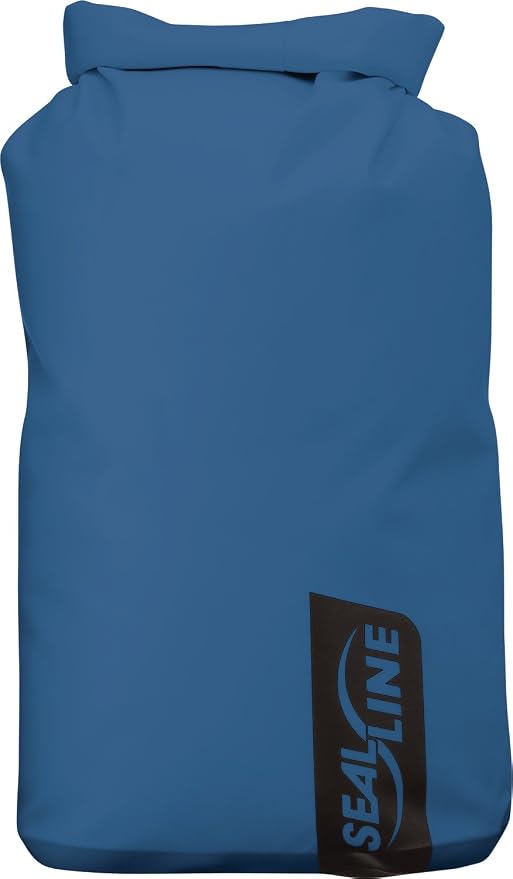
The Discovery 10L makes sense for a bag that will be carried a short distance and then stowed, particularly when you prefer a plain sack over exterior pockets. SealLine documents polyurethane-coated polyester, welded seams, an oval bottom, and its DrySeal roll-top closure.
The manufacturer lists the 10L at 5 by 8.5 by 14.5 inches when correctly closed, which is a useful starting point for checking your storage space. Those are bag dimensions, not a promise that an object of that rectangular size will slide through the opening.
Its appeal is simplicity: fewer features to choose between while you decide how to divide the day’s load. Someone who wants a bag to double as a comfortable shore-walk backpack should look elsewhere, because this selected Discovery sack is not a backpack and should not be confused with the Discovery Deck version.
SealLine distinguishes its waterproof bags from its separate submersible category. Treat that distinction as a purchase boundary, and do not turn a quick-dunk description into an unlimited underwater allowance.
Sea to Summit Big River 20L: room and attachment choices

Choose the Big River 20L when bulkier clothing makes a ten-liter sack awkward or you want several exterior attachment points. Its manufacturer documents side lash points, a light interior, an oval base, and a replaceable buckle; those are useful design differences without proving a comparative durability winner.
The 20L selection gives more room, but it also creates a larger object to stow and retrieve. Before ordering, compare the closed height and base dimensions on the exact size chart with the hatch opening, seat clearance, and lifting path on your own boat.
Exterior lash points are particularly relevant if your alternative is improvising a tight strap around a smooth sack. Choose a restrained position that does not block equipment or movement, and follow the boat and bag instructions rather than treating the buckle as a lifting or towing fitting.
Skip the Big River if you only need a lightweight organizer inside an already protected pack. Sea to Summit explicitly advises avoiding submersion because water can enter through the roll-top; its fabric waterhead number is not a whole-bag immersion depth.

Pack the closure before you pack the boat
Lay the actual trip load on a table before choosing a capacity. Group the things you can leave sealed together, then separate anything you expect to retrieve often; this usually reveals whether one large opening or two smaller bags will be easier to manage.
Leave headroom for the closure and remove sharp edges from direct contact with the bag wall. A box corner, exposed tool, or gritty buckle can create a local problem that a heavier fabric specification does not resolve.
Follow the closure procedure for your exact bag and make the rolls neat across their full width. SealLine specifies at least three tight, wrinkle-free rolls for its roll-top bags; do not apply that sentence as permission to ignore another manufacturer’s instructions.
Think through a wet-hands opening as well as a dry-hands closing. If the outside is soaked, putting it across your lap and opening it above clean clothing defeats part of the organization you worked to create.
When none of these is the right purchase
Choose another category if your primary goal is repeated underwater use, crush protection for a camera, or immediate one-handed access. Waterproofing, impact resistance, and convenient access are separate jobs, and a soft roll-top sack may address only part of your requirement.
Likewise, a dry bag is not flotation equipment for a person, and we do not assign these bags a dependable floating load. Whether a particular packed bag stays on the surface depends on its contents, trapped air, sealing, and condition.
A final dry run is more revealing than another size-chart comparison: pack the bag, close it, place it where it will ride, and retrieve it without disturbing other gear. If that process is awkward on land, change the load or storage plan before you try it afloat.
Check the load one more time
If you bring an additional jacket for a passenger, repeat the packing check instead of treating the printed capacity as spare space you can always use. Keep the closure area clear, and choose a larger bag or a separate bag when the new load makes closing and retrieving the original sack awkward.
Three storage situations to check
On a small open runabout, imagine retrieving a spare layer while a passenger is sitting beside the bag. If the only way to lift it is to move that passenger or pull across controls, a smaller split load may suit the boat better than a larger single sack.
On a kayak, compare the opening in the boat with the bag at its widest packed point, not its empty flattened width. Soft clothing can change shape during packing, while a rigid lunch box creates a shape that cannot be compressed simply because the sack around it is flexible.
For a shore stop, consider which belongings leave the boat together and how you will carry them. A shoulder strap can be convenient for that transfer, but it does not resolve a heavy load that is uncomfortable to carry or awkward to balance.
Finally, distinguish clean spare clothing from wet items returning to the launch. Packing a damp towel back alongside dry layers changes the moisture inside the bag even when its closure keeps outside water out perfectly.
Sources and scope
- Earth Pak Original dry bag — Material, capacity family, strap and D-rings
- SealLine Discovery and closure FAQ — Construction, closed dimensions, closure and waterproof/submersible distinction
- Sea to Summit Big River — Model features, size chart and avoid-submersion boundary
- Amazon exact variant B01GZCUDH6 — Exact model/size/color correspondence
- Amazon exact variant B01N6X726K — Exact model/size/color correspondence
- Amazon exact variant B0BVW5RY6J — Exact model/size/color correspondence
Research-based editorial comparison. No ownership, laboratory testing or hands-on experience is implied.


